

The “Ten Crucial Days” of the American Revolution began with Washington’s crossing of the Delaware on Christmas night, 1776. They continued through the victories at Trenton, the Battle of the Assunpink, and Princeton on January 3, 1777. In little more than a week, Washington’s Continental Army transformed near defeat into renewed hope, saving the Revolution when the American cause appeared close to collapse.
Earlier that December, General Charles Lee’s march across New Jersey and his capture at Basking Ridge on December 13 set the stage. General John Sullivan immediately assumed command and drove the exhausted New England troops westward, crossing the Delaware at Easton and marching south through Pennsylvania. On December 20, Sullivan reached Washington near Buckingham Township in Bucks County, delivering approximately 2,000 desperately needed soldiers only five days before the crossing. Their arrival strengthened Washington’s forces and helped make the extraordinary victories of the Ten Crucial Days possible.

Time For New Jersey to Recognize
The 1776 March to the Christmas Delaware Crossing
Today, no complete historic-marker trail identifies General Lee’s December 1776 march from New York to Bernardsville and General John Sullivan’s march from Vealtown to McConkey’s Ferry on the Delaware River.
Marking the Crossroads of the Revolution
The desperate, ice-choked march of the New England Army across New Jersey in December 1776 was nearly forgotten, its bloody trails washed away by centuries of spring thaws. For generations, the landscape kept its secrets, leaving the public largely unaware of the monumental trials that unfolded beneath their feet.
Today, however, a massive historical movement is underway across New Jersey to pull these stories out of the shadows. As the nation approaches the 250th anniversary of the American Revolution, the state has launched the State Historical Marker Program 250th Initiative through the New Jersey Historical Commission. Moving away from a random, disconnected approach to history, modern historians and preservationists are using these markers to build interconnected, thematic heritage trails.
The blueprint for remembering the “March of the 3000” mirrors several highly successful preservation models already completed or actively rolling out across the state:
- The RevolutionNJ Framework: Operating under the official banner of RevolutionNJ, the state has partnered with the Crossroads of the American Revolution National Heritage Area to deploy unified working groups. Their mission is to look beyond just General Washington’s main movements and meticulously document the unsung reinforcement columns, loyalist skirmishes, and civilian hardships that defined the war.
- The Washington-Rochambeau National Historic Trail (W3R): This completed initiative directly inspires mapping continuous military marches. It explicitly marks and interprets the exact highways and rural encampments French and American troops used as they moved through New Jersey on their pivotal journey to Yorktown.
- The New Jersey Black Heritage Trail: Signifying a modern shift toward tracking thematic historical journeys, this state program designs and installs physical markers highlighting stories of liberation and resilience across the landscape—much like tracking the exact footsteps of the barefoot New England soldiers.
Also, a $30+ million Battlefield Revitalization was approved: This marker initiative is backed by a massive state-level investment to upgrade 10 critical Revolutionary War sites. The crown jewel of this effort is a brand-new, world-class visitor center and museum at Washington Crossing State Park ($29 million), anchoring the very destination the New England Army suffered so brutally to reach.
Through these modern efforts, the bloody footprints left in the snow at Ringwood, Vealtown, and Potterstown are finally being cast in permanent bronze. They ensure that the sacrifices of the Marblehead fishermen and the ragged infantrymen who saved the revolution are preserved for generations yet unborn.
As New Jersey commemorates America 250, General Lee’s and Sullivan’s remarkable December 1776 march across the state deserves recognition as a crucial journey that helped reunite the Continental Army before Washington crossed the Delaware. Using modern technology, the Mr. Local History Project created localized renderings showing how a connected series of historic trail markers could preserve and share this overlooked story.
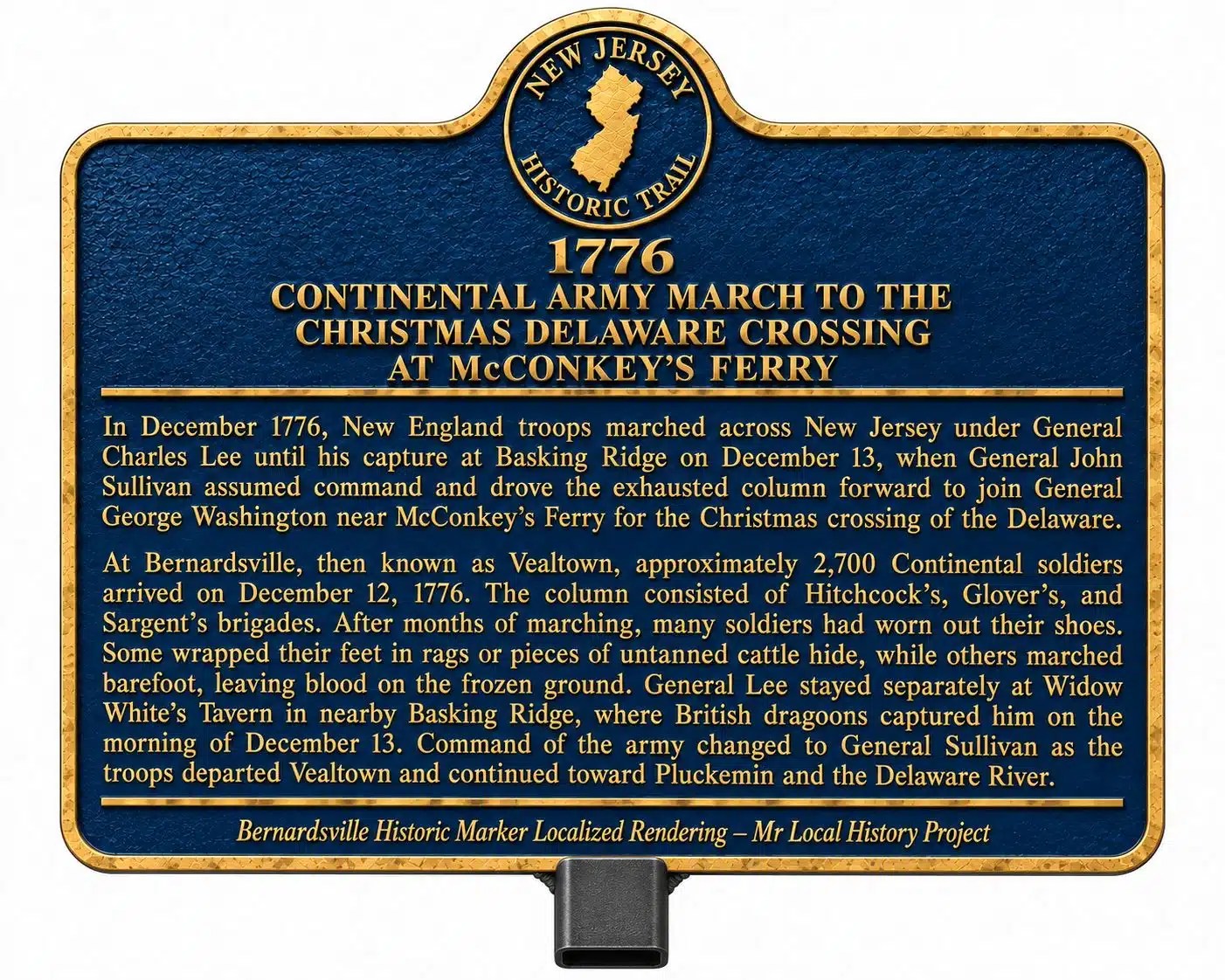
One Man’s Crusade to Document the March to the Delaware Crossing
Today, only a few Revolutionary War markers stand near portions of the route across New Jesey to the Delaware crossing, but most commemorate separate events unrelated to this march. These include the Amwell Militia, Amwell Skirmish, and Colonel Francis Geary markers near Ringoes. A plaque at Dvoor Farm in Flemington claims Sullivan’Sullivan’s camped there, although the Hunterdon Land Trust reports that the connection has not been conclusively documented; the markers also lack consistency to tell the complete story of this critical military march.
In 2025, Hunterdon County historian Spencer Peck proposed a coordinated series of 14 “New England Army: December 1776” markers extending from Ringwood to Phillipsburg. The proposed trail would mark Ringwood, Pompton, Morristown, Vealtown, Bedminster, Lamington, Oldwick, Potterstown, Lebanon, Clinton, Pittstown, Bloomsbury, Greenwich and Phillipsburg. MLH also suggests Basking Ridge, New Jersey, as part of the effort. Consequently, this important march, which delivered almost the entire troops to Washington before the Delaware crossing, remains largely invisible on New Jersey’s roads. Estimates of around 2.400 soldiers crossed the Delaware on December 25, 1776.

📍 The Initial Leg: Suffering in the Snow (Dec 6 – Dec 8)
- 1. Ringwood (Fri, Dec 6): The 3,000-man army arrives under Gen. Charles Lee after crossing the Hudson River. Sensory detail: Many are entirely barefoot, leaving literal trails of blood on the rugged, frozen ground.
- 2. Pompton (Sat, Dec 7): The column passes through in a precise marching order: Hitchcock’s brigade (RI) leads, followed by Glover’s brigade (Mass/CT), the wagon train, and Sargent’s brigade (Mass/NY) at the rear. Glover’s unit includes the famous “Marblehead Regiment”—hardy fishermen who will later row Washington across the Delaware.
- 3. Morristown (Sun, Dec 8 – Thu, Dec 12): The army pauses here for days. Lee is forced to leave 300 sick soldiers behind in the military hospital.
📍 The Climax: Crisis at Basking Ridge (Dec 12 – Dec 13)
- 4. Vealtown / Bernardsville (Thu, Dec 12): The 2,700 remaining walking men arrive. Sensory detail: Shoes are completely worn out after months of marching; men wrap their feet in rags or the untanned hides of freshly killed cattle.
- 5. Basking Ridge (Fri, Dec 13): The Story’s Major Turning Point. The army learns that their commander, Gen. Charles Lee, was captured by British Dragoons while staying at the widow White’s tavern in nearby Basking Ridge. Gen. John Sullivan abruptly takes command. Scouts warn of British troops ahead in Bound Brook, forcing Sullivan to alter their entire course westward to avoid a fight.
- 6. Lamington (Bedminster) (Midday Fri, Dec 13): The army turns at the bridge to cross into Germantown. The human element: The text notes the sudden civilian burden: local farmers who spent all year gathering winter food and firewood suddenly find 2,700 hungry soldiers and horses on their doorsteps.
- 7. Germantown / Oldwick (Late Fri, Dec 13): The army arrives after a chaotic day, continuing to leave a bloody trail in the snow.

📍 The Final Push: The False Alarm & Marathon March (Dec 14 – Dec 15)
- 8. Potterstown (Sat, Dec 14): They camp along the New Brunswick-Easton Road. At 5:00 AM, a terrifying alarm sounds that they are about to be surrounded. In a panic, the soldiers dump out the breakfast broth they are cooking, break camp in a frenzy, and rush toward Hunt’s Mill. The alarm later proves to be entirely false.
- 9. Lebanon (Early Sun, Dec 15): Exhausted from the false alarm, the army pushes through what will become “their longest day”.
- 10. Hunt’s Mill / Clinton (Morning Sun, Dec 15): They cross the bridge, still barefoot and bleeding, moving without stopping.
- 11. Pittstown (Midday Sun, Dec 15): Washington had ordered them to meet boats at Alexandria (Frenchtown), but Sullivan sniffs out a British threat in nearby Penny Town (Pennington). Sullivan overrides orders, staying on the ridge road (now Rt 579) toward Phillipsburg to ensure survival.
- 12. Bloomsbury (Late Afternoon Sun, Dec 15): Pushing through severe physical exhaustion, the bloody trail continues along the Easton Road.
- 13. Greenwich (Evening Sun, Dec 15): In a surreal cinematic moment, the retreating, ragged American column passes a marching column of 500 British prisoners who are being moved east to New York for a prisoner exchange.
- 14. Phillipsburg (Night Sun, Dec 15): Troops finally reach the Delaware River. Ferrymen labor non-stop through the freezing night to cross them into Pennsylvania. Once across, they drop 700 more sick men at a Moravian hospital in Bethlehem before finally embedding with Washington’s main force, just in time to save the rebellion at Trenton ten days later.

Peck’s job began with a campaign to preserve this history in a June 25, 2025 letter to then-Governor Phil Murphy. Peck urged the governor and Legislature to establish a “New Jersey 1776 Commission.” Instead of scattering 30 state-funded markers among unrelated subjects, he proposed using them to tell the connected story of the Continental Army movements that led to the historic December 25 crossing and the Battle of Trenton.
Peck recommended forming four working groups and volunteered to serve with the New England Army group. He then researched the route and prepared 14 individual marker proposals tracing the march of Generals Charles Lee and John Sullivan across New Jersey to join Washington’s forces for the Christmas crossing of the Delaware.
State Officals Drop the Ball
What followed initially was a profound awakening of civic pride across New Jersey’s historic corridors. One by one, local governments responded to Peck’s vision with official resolutions and passionate letters of support. From Bedminster and Bernardsville to Bloomsbury, Clinton, Lebanon, Tewksbury, Franklin, and Readington, local committees and mayors united to ensure this trail of blood and perseverance would be cast in permanent bronze, so future generations would always recognize one of New Jersey’s most historic journeys.
The grassroots effort to cast the permanent bronze markers has ground to a sudden, devastating halt. Despite overwhelming, unanimous backing from towns and mayors across Somerset, Hunterdon, and Warren counties, local historian Spencer Peck was forced to rescind the entire historical marker initiative. In a frustrating turn of events, the New Jersey Historical Commission completely dropped the ball on the America 250 State Historical Marker Program regarding the Delaware march campaign, abandoning the cohesive historical narrative to redirect America 250 funding toward unrelated, politically favored marker efforts that had little to do with America 250.

From the New Jersey Historical Commission, we found the description of the 250 marker program:
“The goals of the New Jersey State Marker Program commemorating the 250th anniversary of the
independence of the United States are two-fold. The first is to install new markers that reflect the vast
and varied history of all New Jerseyans. In preparation for the semiquincentennial, this program is
particularly focused on erecting markers that tell a whole history of the American Revolution, including
its origins and the ways in which its Revolutionary ideals have impacted the state over the past 250
years. “(Read about the entire program.)
Then on January 25, 2026, Peck received a decision:
“The New Jersey Historical Commission would like to congratulate you on your approved historical marker nomination for the State Historical Marker Program! During the approval process, the Advisory Council determined that all marker groupings approved by the Commission will be consolidated into one single marker.“
Leah Baer (she/her)
State Marker Project Coordinator
New Jersey Historical Commission, New Jersey Department of State
Of the 33 markers approved for New Jersey’s State Historical Marker Program 250th Initiative, 21 (64%) were directly related to the American Revolution/250th anniversary, while 12 (36%) were not.
Rather than honoring this cross-county trail of sacrifice, bureaucratic maneuvering reduced the entire effort to a single marker; the project was essentially killed by committee, destroying the momentum. To say the least, Peck was extremely disappointed with their decisions after all the work and approvals.
Still Hope
Nevertheless, the battle to preserve this narrative is shifting to alternative preservation fronts. With state bureaucracy slow-walking the roadside plaques and diverting funds elsewhere, local advocates are exploring other avenues to ensure the trail marker effort isn’t erased from public display and recognition.

All eyes also turn to the state’s flagship Semiquincentennial investment: New Jersey’s brand-new, $29 million Washington Crossing State Park Museum & Visitor Center, which is nearing completion and scheduled to open, and to how it will honor this “March to the Delaware Crossing” history
Don’t Forget:
Extending the Trail Markers into Pennsylvania
The proposed 14-marker New Jersey trail does not have to end at the Delaware River. After reaching Phillipsburg, Sullivan’s troops crossed into Easton and continued south through Pennsylvania toward Washington’s army. Their route through Bucks County ultimately brought them into the forces assembling for the Christmas night crossing of the Delaware. Five additional Pennsylvania markers could complete the story, connecting the Lee–Sullivan march directly to Washington’s attack on Trenton.
- Marker 15 – Easton: “The Army Enters Pennsylvania” Marks Sullivan’s crossing of the Delaware from Phillipsburg into Easton on December 15–16, 1776, and the beginning of the Pennsylvania leg of the march.
- Marker 16 – Springfield Township: “The March South” Marks the troops’ movement through upper Bucks County and their recorded bivouac in the Springfield area as they continued toward Washington’s army.
- Marker 17 – Buckingham: “Sullivan Reaches Washington’s Army” Marks Sullivan’s arrival in the Buckingham area on December 19–20, where his exhausted soldiers received badly needed shoes and stockings and joined the forces gathering under Washington.
- Marker 18 – Newtown: “Preparing for the Crossing” Marks the movement and encampment of Continental troops in the Newtown area as Washington concentrated his forces and prepared for the Christmas night operation.
- Marker 19 – McConkey’s Ferry: “The March Becomes the Crossing.” The fitting conclusion to the trail. On Christmas night, December 25–26, Sullivan and many of the soldiers who had made the long march across New Jersey and Pennsylvania crossed the Delaware with Washington’s army. Sullivan then commanded one of the two main columns advancing toward Trenton—transforming their weeks-long march into part of one of the defining victories of the American Revolution.
While Pennsylvania contains numerous Revolutionary War markers and sites associated with the December 1776 campaign, our research has not identified an existing series of markers commemorating General John Sullivan’s December 1776 march from Easton through Bucks County to join Washington’s army.
About Spencer Peck
Spencer Peck has been a resident of Hunterdon County for 42 years. He earned Bachelor’s and Doctoral degrees. He has been a coin collector and amateur historian since age 10. Accredited Senior Member: American Society of Appraisers (ASA). One of nine ASA-certified numismatic appraisers in the U.S. Over the years, have completed assignments for banks, estates, trusts, the Commodities Futures Trading Commission (CFTC), the FBI, U.S. Customs Service, the DEA, and the U.S. State Department.

Spencer conducted forensic appraisals of rare coins recovered from safe deposit boxes at the JPMorgan Bank branch at the World Trade Center after 911. Hunterdon County member of the 1999 New Jersey Commemorative Quarter Commission. Proposed the design, which was unanimously selected: Washington Crossing the Delaware before the Battle of Trenton in 1776.
Related MLH Posts
Our Readers’ Top 10 MLH Posts this Week


Appendix:
Letter to Governor Murphy

