
Our researchers continue to work on this story, as there are several conflicting points of view we want to explore further. We will update over the next few weeks, but we wanted to share this preview in case you’d like to write to us.
Jersey Lost Racetrack Series

Vailsburg’s First Velodrome, Then a Motordrome, and Then Just a Velodrome
Here’s one of those stories that starts in one place and then takes you on a wild chase to gather up pieces of not just one historic Newark venue but two landmark venues. We introduce you to the Vailsburg Velodrome, also known as the Newark Velodrome, the Newark Vailsburg Velodrome, and the Vailsburg Motordrome, also known as the Newark Stadium Motordrome. Our journey welcomes all the fans of cycling, motorcycles, racecars, and the life of two sporting venues “in the Burg” with many configurations from 1897 to 1930. Our researcher will keep digging. If you have anything to share, there’s a comment section at the end of the post.


Bicycle Board tracks, known as velodromes, were a thrilling yet perilous adaptation of the traditional velodromes. These tracks gained immense popularity throughout America in the early 20th century and were pivotal in the later rise of motorcycle racing as a spectator sport.
Promoters began adapting wooden tracks for motorized bikes in the 1910s, drawing inspiration from bicycle velodromes. Steeply banked and constructed with wooden planks, often pine, these tracks enabled high-speed racing, with riders leaning dramatically into turns and often exceeding 100 mph. The motorcycles were designed purely for speed, usually stripped of brakes to reduce weight, adding to the races’ excitement and danger.
Chapter 1: The First Vailsburg Velodrome (1897)

It’s funny that it wasn’t too long ago when the bicycle was invented. John Kemp Starley of London, England, invented the first same-sized two-wheeled bicycle, known as the “safety bicycle,” in 1885. Of course, men being men, competitions to race these new vehicles became a thing. So what do you do? You build a racetrack for bicycles. The French are credited with the bike racetrack, hence the term “Velodrome” stuck.

Early velodromes. were made of wood planks or concrete and featured steeply banked turns to help riders maintain speed. They were said to first appear in Paris, France. Many don’t know that Newark, New Jersey, was once considered the “cradle of cycling” in what was known as the sport’s golden age. It all began on Memorial Day weekend on May 31, 1897, when over 1,000 spectators made it to the Vailsburg section of Newark near Shooting Park and welcomed the first of what became many versions of velodromes to the area. The initial track was built by British sports promoter John Prince and over 100 men working day and night shifts on the south side of South Orange Avenue, rivaling the nearby velodrome at Waverly Fairgrounds, now Weequahic Park. A 2,000-seat grandstand would later be added after the opening. Other cyclists such as Donald McDougall, George Chapman, Alf Goulet, Percy Lawrence, and Lloyd Thomas all made their presence felt at the Vailsburg Velodrome. And yes, there was East Orange’s Frank Kramer.

Wooden plank velodromes didn’t last long, typically only a few years, as the elements and tire wear wore down the vertical Board planks to a point where it was easier to rebuild than to replace sections of the track. The 2nd Vailsburg Velodrome was located on the North side of South Orange Avenue and Munn Avenue in the Vailsburg neighborhood. It operated from 1907 until its demolition in 1930. The velodrome replaced the earlier, smaller wooden track that had been in use since 1897 on the south side of South Orange Avenue. The Velodrome was primarily a cycling venue, but it hosted other events, such as boxing.
Newark, New Jersey, was once considered the “cradle of cycling” in what was known as the sport’s golden age.
The Golden Age of Bicycle Racing in New Jersey – Michael C. Gabriele
The first Vailsburg Velodrome continued operating for several years, but at 1:30 AM on the morning of February, the track was engulfed in flames and severely damaged. You’ll become a trend. Luckily, repairs were made, and the track reopened for the 1904 season on April 10. On 7,000 spectators overflowed the 2,000-seat grandstands, watching Fred Kr, Amer win the 1/2-mile pro race.
Vailsburg Velodrome Joins the New Electric Park (1903)
Shooting Park had fallen into disrepair, and in May of 1903, Shooting Park became Electric Park. Shooting Park showcased athletic venues for sport and dressage (horses). With the existing Vailsburg Velodrome on the Park’s west side, the two attractions were a win-win.


Chapter 2: New Vailsburg Velodrome 1907
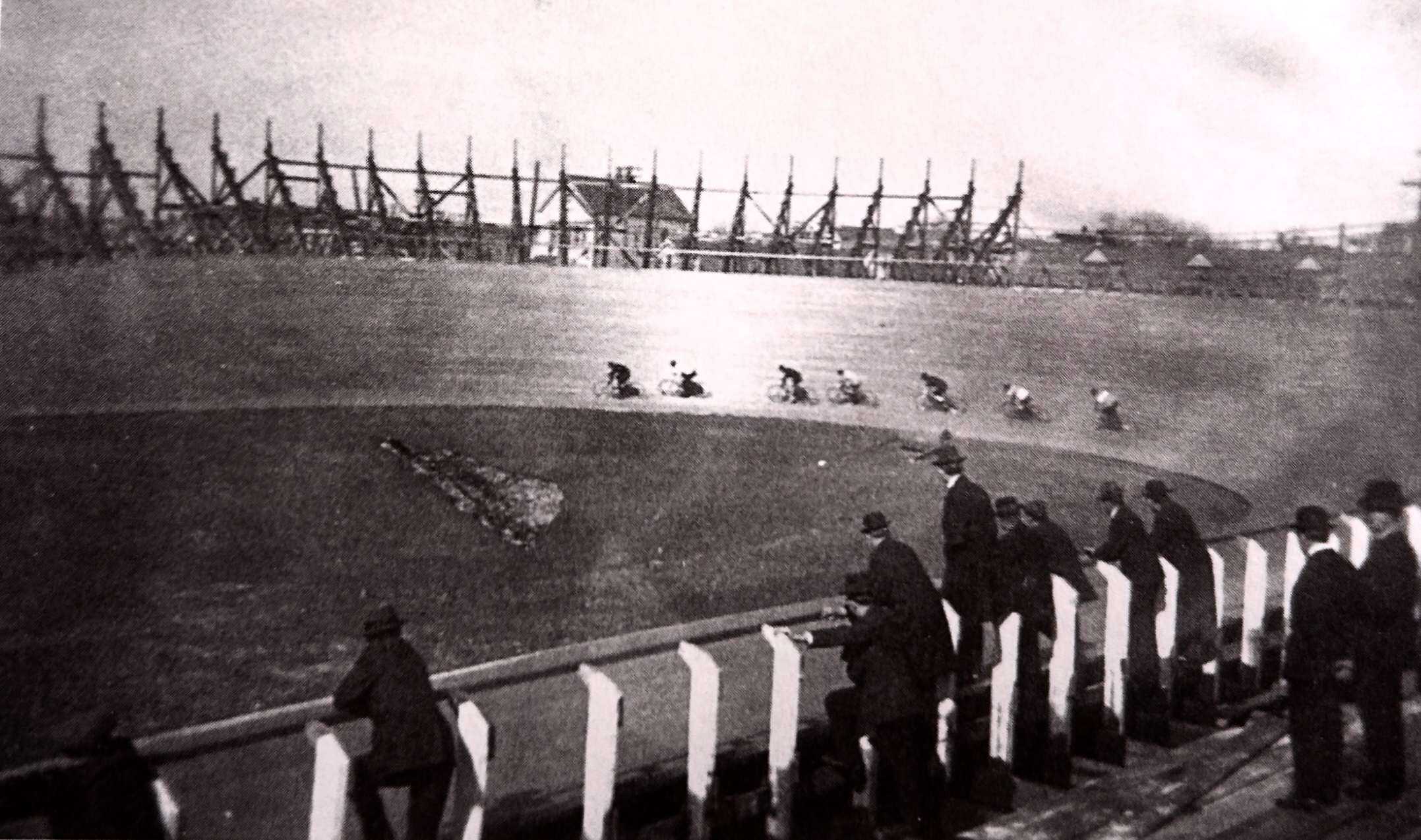
A new Vailsburg Velodrome was built in 1907, and this time, the facility would now accommodate up to 12,500 spectators. The Vailsburg track was six laps to the mile (1/6-mile), 293 yards (300 meters) per lap, and was designed by John M. Chapman. The track featured steeply banked turns pitched at 52 degrees and straightaways at 25 degrees, allowing for high-speed races. As you will see, this velodrome became a stadium because it could accommodate six times as many spectators as the previous venue.


Chapter 3: New Velodrome (1910-1911) Part of Electric Park “White City” Project
Vailsburg continued its tradition during the golden age of racing with one of the largest circular board-plank-lined “Saucer Tracks,” so named because its steeply banked design resembled a large saucer. They also allowed the spectators (over 12,000), seated in grandstands above the top of the racing surface, to get a close-up look at the action. Fans often stood along the barrier railings to watch the riders, who flew past at incredible speed just inches from the spectators.


After rain delays postponed the April 9, 1911, opening, the new Newark Velodrome opened on Easter weekend, April 16-17, 1911, with high winds and snow squalls. Still, the new track opened to 5,000 spectators on the North side of South Orange Avenue (at the intersection of Munn Avenue), across the street from the previous Velodrome. Click to see the two articles below:


1912 World Cycling Championships Held at Vailsburg
At the time, the Vailsburg Velodrome was a state-of-the-art track with a 12,500 capacity that drew 20,000 for the UCI World Cycling Championships in 1912, the fans overflowing into the infield. UCI Track Cycling World Championships were held in Newark, New Jersey, from August 30 to September 4, 1912. The event was sanctioned by the Union Cycliste Internationale (UCI), the governing body for cycling. Fred Kramer, who lived in nearby East Orange, won the 1912 UCI Track Cycling World Championships.

Union Cycliste Internationale serves as the international governing body for cycling, and the first recognized world championship was held in Chicago in 1893, with the event continuing to this day. Kramer didn’t only win the 1912 World Cycling Championship; he won the World Championship at hChampionshipk, the Vailsburg Velodrome! The American team did pretty well that year as well.


Another Vailsburg Track Fire (1915)
On September 12, 1915, a fire leveled what had become a world-famous velodrome after the 1912 World Championships were held there. The Essex County Park Commission hired a wrecking company to clear the remains along with the adjoining Electric Park in 1917. One good thing to come out of that tragedy was that Newark got a new Vailsburg Park that still exists. Sadly, there are no markers identifying these great Board tracks. We’re gonna see if we can change that.

Chapter 4: Another Vail’s Velodrome Revival
From the ashes comes the phoenix, and a new Vailsburg Velodrome was built featuring an improved Board track and infrastructure, making it one of the leading cycling venues of its time.
A noteable reference is Howard Benton “Poke” Freeman (1877–1937), an accomplished professional bicycle racer, illustrator, and newspaper cartoonist whose firsthand knowledge of the sport made him one of America’s premier cycling artists. After competing on tracks across the United States, he became a cartoonist for the Newark Evening News in 1912 and a frequent contributor to Motorcycle & Bicycle Illustrated, where his humorous and accurate illustrations chronicled the personalities, races, and board tracks of the golden age of cycling and motorcycle racing. Living in East Orange, New Jersey, Freeman’s work provides an invaluable visual record of the Newark Velodrome and its racing community.


Another Newark Velodrome Fire (1926)
One more time! Fire and a rebuild.


Chapter 5 – The.Velodrome Era Ends in Newark, New Jersey
In 1930, after the racing season was completed and the lease concluded, the decision was made to end racing and demolish the track. An apartment building replaced the hallowed grounds of cycle, motorcycle, and auto racing. The legacy of Board tracks influenced modern track and motorsports design. While the velodromes are long gone, their daring spirit is carried on through vintage cycling and motorcycle clubs, exhibitions, and films celebrating Board racing’s early days. These tracks and their racers remain essential in Board track racing history, remembered for their innovation, excitement, and danger.
Chapter 6: The Vailsburg Stadium & The Newark Motordrome
The Velodrome for Motorcycles – The Motordrome
Newark Vailsburg Motordrome Challenges Velodrome Racing

New Jersey was home to several prominent motor domes. It attracted thousands of spectators eager to watch daring racers, including teams sponsored by manufacturers like Indian and Harley-Davidson. Similarly, the Asbury Park Motordrome was a regional hotspot, hosting major motorcycle racing events and showcasing technological advancements in racing. Atlantic City also hosted temporary boardwalk planks during large events to capitalize on the city’s vibrant tourism industry.


Board track moto. Motorsports racing occurred on specially built oval tracks known as motor domes. Sometimes referred to as “amusement stadiums,” these tracks were constructed from wooden planks, typically 2x4s, hence the term “Board track.” The tracks were steeply banked, and this one had 60 degrees of banking (most topped out at 40 degrees) to allow motorcycles to maintain 90mph while cornering. Banking also added to the spectacle as riders raced perilously close to the top edge of the track.

Source: Newark Sunday Call. January 28, 1912.

The new 8,000-seat.At Newark Stadium Motordrome, also called the Vailsburg Stadium Motordrome, was the new Board track racing venue across the street from the Velodrome, but this one was designed for motorsports. Built in the Spring of 1912 by Zacher & Curry for $30,000, the Eastern Motor Racing Association funded the new stadium. The new 1/4-mile circular Board plank bowl track with a 60° angle was unfathomable if you think about it.

The turns at Daytona International Speedway were built at 31 degrees, and I’ve walked up it, and it wasn’t easy.I can’t even imagine the guy in the photo below trying to get up a 60-degree bank. What an incredible stadium!
The venue sat at the corner of Broad Street and Orange Street in downtown Newark near the University section of town.


Motordrome owner Ingles Moore Uppercu opened the Vailsburg Stadium Motordrome on July 4, 1912; Mayor Jacob Haussling fired the starter pistol for the first race. Haussling was the 24th Mayor of Newark, New Jersey, who served four terms from 1907 to 1915.
Tragedy Strikes Motordrome Sunday, September 8, 1912
On Sunday, September 8, 1912, a spectator crowd of more than 5,000 gathered to watch the inaugural races at the Motordrome. Many spectators looked down onto the track from the bleachers at the top of the boards, cramming their cheering barriers, which separated them from the riders.

The thirteenth and final race of the program was a five-mile handicap. Five riders started the race. While dicing for the lead, 19-year-old “Speed King” Eddie Hasha from Texas ran near the top of the racing surface on the fourth lap. Centrifugal force increased the danger when he took a sharp turn at more than 90 mph (145 km/h), and his bike went, causing him to go as well. He leaped the track and scraped the railing at the top, one wheel inside the grandstands and the other hanging above the track, striking many spectators sitting on the lower aisle. Hasha’s bike then hit a large wooden post, and the rider was hurled into the crowd, being killed almost instantly with a broken neck.

The frame of Has.ha’s heavy Indian 8-valve machine then slid down the bank into the path of fellow rider Johnny Albright, 21, of Denver, Colorado, who was traveling at full speed. He could not avoid the impact, hit the bike, and was thrown from his motorcycle, landing 30 feet ahead along the track. He rolled unconscious to the bottom of the embankment and was taken to Newark’s German Hospital, where he was pronounced dead three hours after the crash. He never regained consciousness.
The spectators, four boys and two men, all from Newark, were struck by the front wheel of Hasha’s motorcycle. One of them, Russell Dalley, aged 11, was killed on the spot. William Barnett, 24 years old, and one of the three other youngsters, James Loefing, about 16, passed away shortly afterward. Edward Fischer, 17, and Thomas Foehner, 14, passed away the following day at Newark City Hospital.

“Murderdrome” Nickname Sticks
After the tragic accident, the Motordromee remains open, offering bicycle “velodrome style” racing on the track. It didn’t last long.

The Newark Motor. The Motordromee tried to run other events at its track, which closed in September 1912. The accident demanded attention, and the Newark Common Council passed an ordinance in December 1912 banning motorcycle races at Board tracks within the city limits. This ban ultimately led to the venue’s permanent closure.


On November 25, 1912, the Newark Motordrome went up for Sheriff’s sale. On November 25, 1912, it was reportedly sold to a Mr. William Gerch, vouched for by George W. Cross, Eastern Racing Association. Star-Ledger

In 1913, two companies, the Newark Stadium Motordrome Company and the Newark Stadium Motordrome, were formed as amusement companies to consider building automobile and motorcycle tracks in the Boston area. That’s another story for another time.
Last Chapter: In the End…
Despite its popularity, board-track motorcycle racing was fraught with risks: high speeds, the lack of brakes, and minimal safety precautions led to frequent, often deadly incidents. The danger extended to spectators, who were vulnerable to flying debris or motorcycles crashing into the stands. This earned the tracks the ominous nickname “murderdromes.” Maintenance costs for the wooden tracks were high, as they were prone to weathering and damage, further undermining their utility. The economic hardships of the Great Depression made it difficult for motordromes to survive. By the late 1920s and 1930s, the sport had declined mainly in favor of track and dirt-track racing, with paved ovals considered safer and more practical.


Vailsburg itself. It was an independent municipality until 1905, when the city of Newark annexed it. Vailsburg Park is located on 30. Covert is part of the Essex County Park System, the first county park system in the United States. Electric Park was once located on the land that later became Vailsburg Park. Electric Park was an amusement park, part of a wave of “electric parks” nationwide that were powered by and named after the advent of electric lighting. Electric Park effectively shut down operations around 1912.

Although park construction started in 1917, significant improvements were not completed until the late 1920s. The Olmsted Brothers designed broad lawns that evoke a sense of creation, while large trees line the perimeter, surrounding the ballfields, playgrounds, and a bandstand.
MLH Remembers Jersey Motorsports with New “Wear Lost Jersey Motorsports History” Merch

One More Thing…….
After 1930, other area velodromes continued to operate, including Weequahic Park, pronounced Week (Newark-Quake (Newark), and Nudomes. Nutleyher velodrome in Newark, Olympia, and elsewhere in a different part of Newark served as a general-purpose venue. It hosted various events, including baseball games, fairs, and community gatherings. Unlike the Newark Velodrome, which specializes in cycling and motorcycling, Olympia Park focuses more on team sports and public entertainment. It was a hub for broader recreational and social activities in the city. While both venues played key roles in Newark’s sports and entertainment history, their purposes and contributions were distinct. The Newark Velodrome stood out for its innovation in track design and its role in cycling and motorcycle racing. At the same time, Olympia Park was a versatile space for community events and team sports.
Newark was also home to two great cycling clubs — the Bay View Wheelmen and the Alpine Wheelmen — who staged weekly race programs at the half-mile Weequahic Park race track.” Bodian was the publicist, and the Bay View Wheelmen were the host for the 1939 National Dirt Track championship at Weequahic Park.

Source: Wall of Death by David Gaylin


When you have a spare hour, check out this great film.


I will post an article from September 7th when Eric Hasha refused to race at Vailsburg BEFORE his fatal accident.
Thx – also looking for Newark Velodrome hero Frank Kramer’s Cadillac ad that stated “Even Frank Kramer Drives a Cadillac.”