

For centuries, historians have relied on books, letters, artifacts, and exhibits to tell the stories of the past. But what if visitors could do something more? What if they could sit down and talk with Elias Boudinot, Henry George, or another historical figure and ask questions directly?

That is the vision behind New Jersey’s own HistOracle AI, a young company founded by three Jersey technologists who believe artificial intelligence can help museums and historical organizations engage a new generation without replacing historians, classrooms, or traditional exhibits.
“We’re not trying to replace museums,” co-founder Arnav Sacheti explained. “We’re trying to create something that works alongside them and leverages the best information and the expertise that already exists.”
Three Technologists with a Passion for History
United by a passion for technology and New Jersey’s rich Revolutionary War history, founders Arnav, Preetham, and Arun are bringing the past to life through HistOracle AI. Arnav’s fascination began growing up in Edison, where he discovered his home stood near the pivotal Battle of Short Hills, inspiring a lifelong interest in the state’s role in America’s fight for independence.
Together, the three founded HistOracle AI in May 2025, combining expertise in artificial intelligence and computer science with historical storytelling. Today, they partner with New Jersey historical societies and other Mid-Atlantic cultural institutions to create interactive AI experiences that make Revolutionary War figures and local history more engaging and accessible to a new generation.

The company’s name combines History, Oracle, and now artificial intelligence. The founders envisioned a platform that could draw upon the wisdom preserved in historical records and transform it into something interactive and conversational. Not a fortune teller, but a guide to the past.

HistOracle AI’s three New Jersey technologists have backgrounds in computer science and data science. Their journey began in 2025, while they were working with the Henry George School of Social Science in New York to develop a new way to communicate personally with historical figures. It’s been an exciting journey ever since.

HistOracle AI founders at the Ross Farm, 2026. Arun Kashyap, Arnav Sacheti, and Sai Preetham (left to right). Source: Ross Farm
“We were very excited when we got this idea of what if any historical figure could actually talk to you and answer your questions,” recalled Sai. But building such a system required more than simply pointing artificial intelligence at the internet. “So then we decided what if we just grounded it to whatever books they wrote, whatever letters, and all these personal items they have,” he explained. “Then we can improve the personality and bring it as close to reality as possible.”
For Arun Kashyap, the project has become much more than a technology exercise. “We got to meet awesome people and share different perspectives,” he said. “The feedback that you get is always very valuable. It’s a continuous journey.”
“Isn’t this thing just making stuff up?”
HistOracle’s founders recognize that artificial intelligence raises legitimate concerns. Their answer is grounding. They build characters on carefully selected writings, letters, and source materials, with historians helping determine what goes into the system. The goal isn’t to invent new history, but to let historical figures speak through the evidence they left behind.
HistOracle AI’s First Character: Henry George the Economist
Their first character was Henry George (1839-1897), the famed American political economist and author of the influential book Progress and Poverty. Working with the Henry George School, the team created an experience set in the 1890s that allowed visitors to converse with George and explore the ideas that made him one of the most influential thinkers of his day.

Our biggest challenge was balancing personality with accuracy. Too much freedom and the character risks becoming fiction. Too many restrictions and the conversation becomes lifeless. Finding that balance remains an ongoing process.
Arnav Arnav Sacheti, HistOracle AI
Months of testing and refinement followed. Henry George became HistOracle’s proving ground. Here, the founders developed the guardrails, voice synchronization, animation, and document retrieval methods that would eventually become the foundation of HistOracle AI.
New AI Character – Elias Boudinot
HistOracle’s second major historical character brought them to Somerset County, New Jersey. Working with the Ross Farm Museum in Basking Ridge, New Jersey, HistOracle AI chose Elias Boudinot (pronounced Boo – Dee- Know), one of New Jersey’s and one of America’s often overlooked early American founders.

Born in Philadelphia in 1740 and later residing in New Jersey, Boudinot served as President of the 2nd Continental Congress, represented New Jersey in Congress, and later became Director of the United States Mint under George Washington. He spent his final years near Basking Ridge and died in 1821.
Although he accomplished much, his story has largely faded from popular memory. HistOracle’s goal was to change that. Through conversations and guided experiences, visitors could meet Boudinot and even accompany him on a journey to George Washington’s inauguration, transforming a historical figure into a storyteller.
Elias – Meet Elias.
Elias Himself was Very Excited
My own introduction to HistOracle AI came not through a computer screen but through a trusted voice steeped in history. While attending Ross Farm Museum’s Flag Day open house, I asked longtime Revolutionary War reenactor and Ross Farm volunteer Hank Barre, portraying Elias Boudinot, what I absolutely needed to see before leaving.

Barre didn’t hesitate. “Before you leave, you’ve got to go in and see these tech guys and talk to their AI version of Elias Boudinot. It blew me away.”
Intrigued, I walked into the exhibit and encountered something unlike anything I had experienced before. What began as a recommendation from one interpreter of history soon became an encounter with another—a digital Elias Boudinot capable of conversation, storytelling, and guiding visitors through moments from America’s founding. It was a meeting of two worlds: the traditional art of historical reenacting and a new form of interactive history powered by artificial intelligence.
Technology’s Virtual Experience
HistOracle has developed two approaches to sharing history. The first method allows visitors to simply converse with a historical figure. The second, called Journey Mode, guides users through important moments in their lives before encouraging deeper conversations. Building those personalities, however, requires much more than feeding information into an AI model.

The team works closely with Bruce McArthur, a Ross Farm trustee with deep knowledge of Elias, to decide which documents should form the project’s foundation. They incorporate letters, writings, and source materials, many of which are unavailable to conventional AI systems, to ensure historical accuracy.

According to the team, one important rule they incorporated is that historical figures know only what they would have known during their own lifetimes. Ask Henry George about Barack Obama or Donald Trump, and he will simply tell you he has no idea who they are.
Public Interaction and Learnings
HistOracle AI’s first opportunity to observe public interaction with its new Boudinot interactive character came during Ross Farm Museum’s Flag Day event at Ross Farm in Basking Ridge, part of their America 250 Flag Day celebration on Saturday, June 13, 2026. The team said the response was overwhelmingly positive. Visitors who had never heard of Elias Boudinot quickly became immersed in his world. Some needed a little help getting started, which reinforced the importance of something called “The Journey Mode.”
The Journey Mode is a way that people could be introduced to Mr. Boudinot,” said the team in our interview. “Many people didn’t really know who he was so this new Journey sequence is a great way to introduce them to a character before they begin asking them questions.” Many visitors became deeply engaged once they connected Boudinot’s world to their own towns or interests.
But then came the sports fans. Another historic event was on many guests’ minds, especially the kids, as the NY Knicks played Game 5 of the NBA championship finals that night. “Elias, are the Knicks going to win tonight?” recalled Sacheti with a laugh. Those moments reminded the team of something important. They incorporated it into their models. Technology alone isn’t enough. Successful storytelling requires context, guidance, and helping visitors understand why the person standing before them matters.
Under the Hood
While visitors experience what feels like a simple conversation, a sophisticated technology stack powers HistOracle AI behind the scenes. The platform combines large language models (LLMs) with retrieval-augmented generation (RAG), allowing characters to draw on curated books, letters, writings, and other primary-source materials rather than the open internet. Document retrieval, conversation memory, prompt-based personality modeling, voice interaction, and facial animation work together to create immersive experiences while extensive guardrails help maintain historical accuracy. The characters are always limited to knowledge of their time, so they don’t reference current events. Sorry all, Elias didn’t know the Knicks would win in 5.
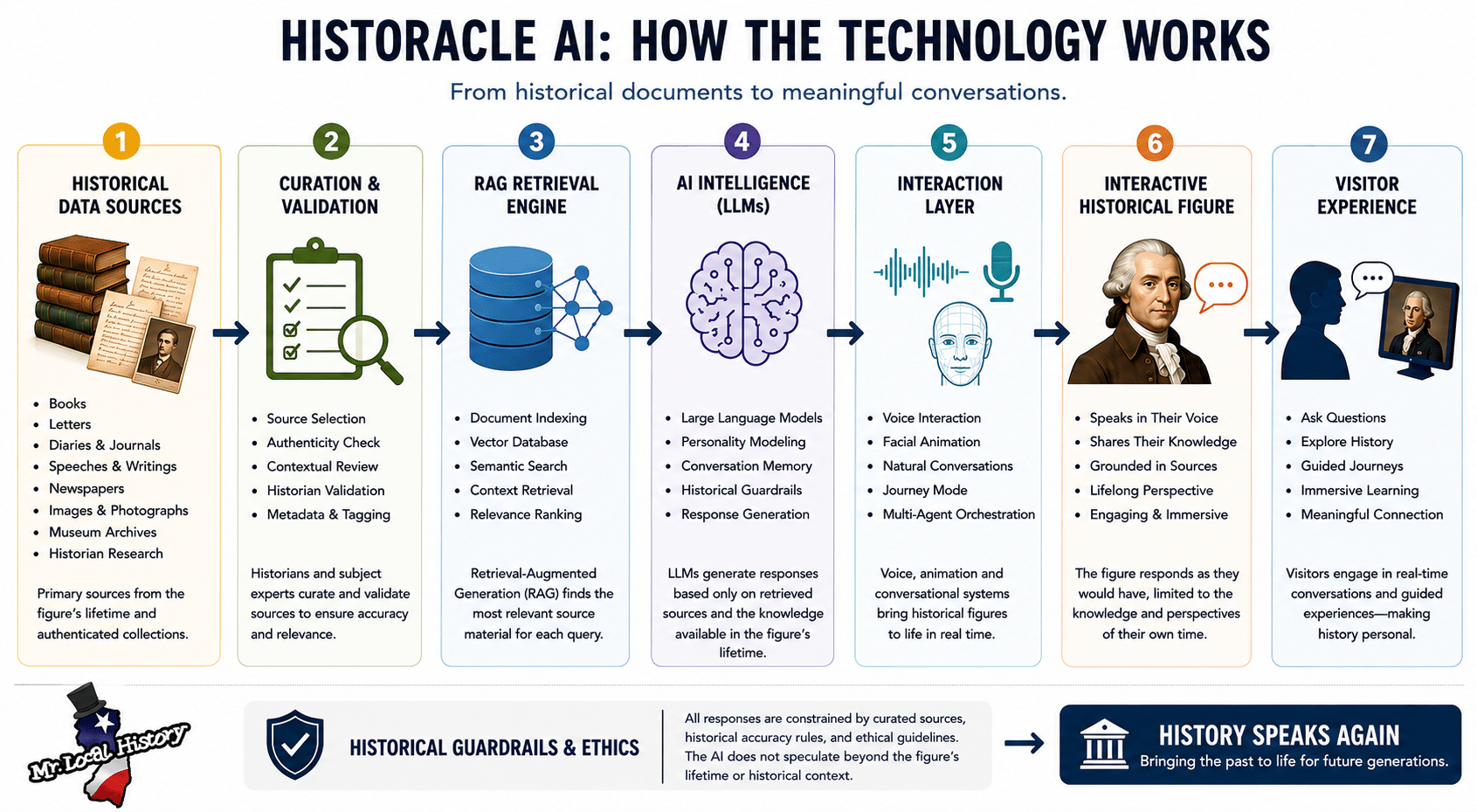
Historians carefully select source materials, and each character is constrained by the knowledge and perspectives available in their lifetime. The result is a contextual, historically grounded conversational experience designed not to replace museums, classrooms, or historians, but to complement them and provide visitors with new ways to engage with the past.
Looking Back While Looking Ahead
Looking back, it seems fitting that my introduction to HistOracle AI came from Hank Barre, Basking Ridge’s own real-life Elias Boudinot. For decades, Hank has brought Elias Boudinot to life through traditional reenacting. HistOracle AI offers another way to continue that same mission. One interpreter wears eighteenth-century clothing. The other exists inside a computer. Yet both share the same purpose: ensuring that Elias Boudinot and countless others are not forgotten.
With America’s 250th Anniversary in full swing, HistOracle hopes to partner with historical organizations nationwide. Longer term, the founders envision their technology supplementing history classrooms and creating new ways for students to engage with the past.

HistOracle AI is not replacing historians, museums, or reenactors. It is simply adding another voice to the conversation. Perhaps that is HistOracle AI’s greatest promise. Not to replace history. But to make it speak again.
HistOracle AI Demonstration:
Henry George
Henry George was an American political economist, journalist, and social reformer best known for his influential 1879 book Progress and Poverty. Born in Philadelphia in 1839, he spent much of his career in California before becoming an internationally known speaker and writer.
George tried to answer a question that troubled many people during the Industrial Revolution: Why does poverty persist even as society becomes wealthier? He concluded that the community, rather than individual owners, created the value of land. Because of this, he argued that taxes on labor and production should be reduced or eliminated and replaced with a single tax on land values. This idea became known as Georgism.

Some points you can discuss with Henry:
Influence: Inspired reformers worldwide and influenced thinkers such as Leo Tolstoy, Sun Yat-sen, and Winston Churchill.
Born: September 2, 1839, Philadelphia, Pennsylvania.Died: October 29, 1897, New York City.
Occupation: Journalist, economist, and political reformer.
Most famous work: Progress and Poverty.
Core idea: Tax the unimproved value of land rather than wages, buildings, or commerce.
See the complete interview with New Jersey’s own HistOracle AI team,
moderated by Brooks Betz from the Mr. Local History Project
To open your own discussion with HistOracle AI, contact them on their website – https://historacle.ai/partnerships


Funny about this – we just saw Teddy Roosevelt talking with President Trump at the opening of his new library – Pretty cool – https://www.youtube.com/watch?v=fWKFiUICLZE