

If you asked most American sailors to name the single most recognized burgee in the country, the answer is almost always the burgee of the New York Yacht Club. That recognition comes straight out of history. Founded in 1844, the New York Yacht Club became the dominant institution in American sailing during the 19th century, and its burgee quickly became visual shorthand for elite racing, international competition, and the rise of the United States as a serious sailing nation.

The club’s burgee is simple and instantly recognizable from a distance, which is exactly what early burgees were meant to be, but its fame comes from where it appeared.
For more than 130 years, New York Yacht Club yachts defended the America’s Cup, the longest winning streak in international sport, and that small triangular flag was flown at nearly every one of those victories. As a result, sailors around the world learned to recognize the burgee long before they could recognize individual boats.


The America’s Cup trophy was first awarded in 1851 and remains the oldest competition in international sport. The original Cup was commissioned by the UK’s Royal Yacht Squadron and manufactured in London by Garrard and Company, not by Tiffany. The silver trophy itself is a modest-sized, elegantly proportioned ewer standing about 27 inches tall and weighing roughly 8.4 pounds, with later base collars added over time to carry the engraved names of winning clubs and teams, bringing it to its current height of 44 inches and a weight of over 30 pounds.
Unlike many American sporting trophies later produced by Tiffany and Company, the America’s Cup was created in Britain and was intended from the start as a challenge trophy for international yacht racing rather than a domestic championship award. It is awarded to the winning yacht club rather than to an individual skipper, reinforcing its identity as a club-to-club and nation-to-nation contest.

For more than 130 years, the America’s Cup was defended by the New York Yacht Club, creating the longest winning streak in the history of international sport and permanently linking that club, and its burgee, to the most famous prize in sailing.

That base (about 20 cm / 8 inches tall) was the first of two added over the years (the second came from Garrard in 2000).
New Jersey Hosts Eight America’s Cup Challenges
For a quarter century, the greatest stage in world yacht racing sat not off some distant ocean course, but directly off the New Jersey shoreline. During the long defensive reign of the New York Yacht Club in the America’s Cup, the decisive races were sailed on the open waters off Sandy Hook and across the approaches to Raritan Bay. From the beaches and headlands of New Jersey, spectators could watch the most advanced racing yachts on earth pass back and forth across the horizon, their towering rigs and vast spreads of canvas filling the sky.

With Thomas Edison in New Jersey, he actually had film crews from Sandy Hook Bay to film the events. These are some of the earliest films ever taken of live yachting action. There are seven film clips that our researchers have found from the Library of Congress.
By the 1890s, the yachts that gathered off New Jersey for these matches were nothing short of floating monuments to speed and engineering. American defenders such as Vigilant, Defender, and Columbia were centerboard sloops stretching well over 120 feet in overall length, carrying crews in the mid-30s and driving enormous sails on masts that rose higher than many coastal buildings of the day. Across the starting lines came the challengers from Great Britain, including Valkyrie II, Valkyrie III, and the Shamrock yachts, long, lean cutters built to wrest the Cup away from the Americans. When these fleets assembled off Sandy Hook, the water became a narrow corridor for giants, watched by hundreds of spectator steamers and thousands of people lining the coast.

Yacht shown: Vigilant (defending yacht, New York Yacht Club).
Challenger: Valkyrie II (United Kingdom).
Final result: Vigilant wins the match 3 0 and successfully defends the America’s Cup.

Yacht shown: Defender (defending yacht, New York Yacht Club).
Challenger: Valkyrie III (United Kingdom).
Final result: Defender won the match 3-0 and successfully defended the America’s Cup.

Defender: Columbia (New York Yacht Club)
Challenger: Shamrock I (United Kingdom)
Final result: Columbia won the match 3 0 and successfully defended the America’s Cup.
For New Jersey, the history of the America’s Cup falls very clearly into 2 distinct periods, both tied directly to successful defenses that appear on the trophy itself. The latter, more familiar period runs from 1893 through 1920, when the Cup matches were sailed on fixed courses off Sandy Hook and across the approaches to Raritan Bay, and were organized as a formal defender-versus-challenger series. In this era, the defending yachts of the New York Yacht Club faced a single foreign challenger and raced a defined match series with published scores. These New Jersey defenses were won by Vigilant in 1893, Defender in 1895, Columbia in 1899 and again in 1901, Reliance in 1903, and Resolute in 1920. These victories are the classic Sandy Hook era that modern sailing history recognizes as standardized America’s Cup match racing, and each winning yacht and defending club is engraved on the Cup, permanently linking New Jersey waters to the most famous series in the sport.
The earlier period, from 1870 through 1887, also saw true Cup defenses, as recorded on the trophy. Still, they sailed under much older and more flexible racing formats that predate modern match racing. These early challenges were still defended by the New York Yacht Club in New Jersey waters, off in New York Harbor and the lower bay, but the structure could involve fleet-style starts, rotating defenders, or multiple defending yachts sharing the series, rather than a single boat representing the defender throughout.
Even so, each of these events produced a recognized defending winner whose name appears on the Cup. The successful New York Yacht Club defenses in this earlier New Jersey period were won by Magic in 1870, Columbia and Sappho jointly in 1871, Madeleine in 1876, Mischief in 1881, Puritan in 1885, Mayflower in 1886, and Volunteer in 1887. Although the race formats differed from the later head-to-head series, these were still formal America’s Cup defenses, officially recorded, and they form the first chapter of New Jersey’s role in protecting the Cup, long before the famous Sandy Hook match-racing era took shape.
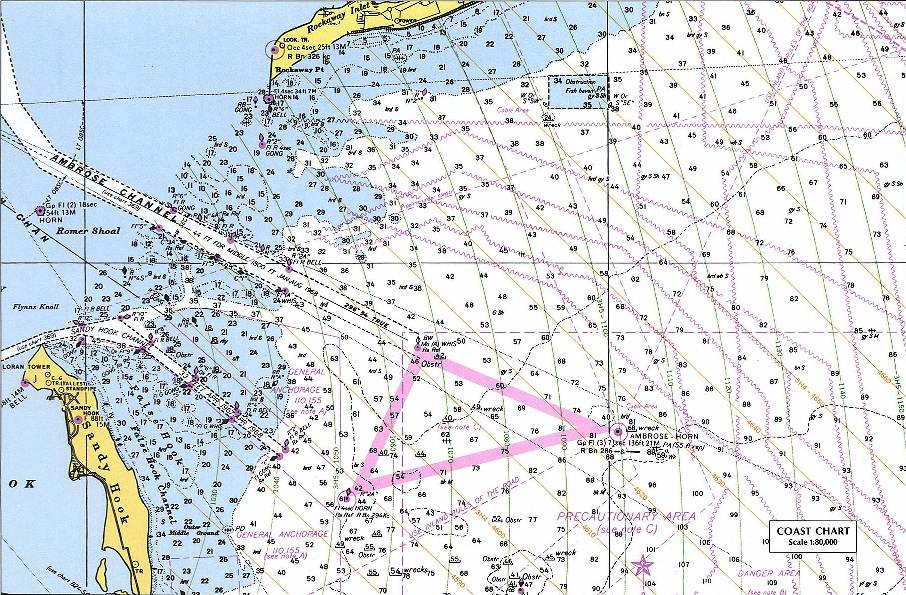
Beginning in 1883, the race committee moved the courses out into open water off Sandy Hook to avoid congestion and poor wind conditions inside the harbor. Every match from 1899 through 1920 was sailed on offshore ocean courses off Sandy Hook.
The grandeur reached its peak in 1903, when the defender Reliance appeared off the coast of New Jersey. At roughly 143 feet overall and carrying between 50 and 60 men on Board, she was the largest and most powerful racing yacht ever built. When she accelerated across the Sandy Hook course, her wake stretched far behind her, and her towering rig dominated the skyline. It was an era when speed came from size, workhorse, and daring design, and New Jersey waters became the proving ground for the boldest naval architects in the world.

Yacht shown: Reliance (defender, New York Yacht Club).
Final result: Reliance successfully defended the America’s Cup by defeating Shamrock III of the United Kingdom, 3 0.
New Jersey America’s Cup Campaigns
Sir Thomas Lipton was a Scottish-born businessman and yachtsman, best known as the founder of the global tea company Lipton, and he became one of the most determined figures in the history of the America’s Cup through his personal mission to win the trophy for Britain. After earlier failures outside New Jersey, he focused his major efforts on the offshore courses off Sandy Hook, personally backing and organizing the British challenges with Shamrock I in 1899, Shamrock II in 1901, Shamrock III in 1903, and finally Shamrock IV in 1920, serving as owner, patron, and campaign leader rather than designer or skipper.

Of those 4 challenges, Lipton’s final campaign was Shamrock IV in 1920, and his overall record as a challenger was 0 wins and 4 losses, with an individual race record of 2 wins and 12 losses. Historians generally estimate that he spent about £500,000 on his Cup efforts, which is roughly equivalent to about £69,000,000 in today’s money when adjusted for modern purchasing power, making his pursuit one of the most expensive privately funded sporting campaigns of the early 20th century.
| Year | Challenger | British Skipper | Challenger | Defender | Skipper | Finals |
| 1870 | Cambria | James Ashbury | UK | Magic | Franklin Osgood | NA |
| 1887 | Thistle | John Barr | UK | Volunteer | Hank Haff | 2-0 |
| 1893 | Valkyrie II | John Barr | UK | Vigilant | Hank Haff | 3-0 |
| 1895 | Valkyrie III | John Barr | UK | Defender | Hank Haff | 3-0 |
| 1899 | Shamrock I | UK | Columbia | Charlie Barr | 3-0 | |
| 1901 | Shamrock II | UK | Columbia | Charlie Barr | 3-0 | |
| 1903 | Shamrock III | UK | Reliance | Charlie Barr | 3-0 | |
| 1920 | Shamrock IV | Charles E. Nicholson | UK | Resolute | Charlie Adams | 3-2 |
Even as technology advanced, New Jersey remained the setting. In 1920, the match between Resolute and Shamrock IV returned the Cup to the same waters off Sandy Hook and the lower bay. These new generation yachts were smaller and more efficient, sailed by crews of just over 20, marking a turning point in how elite racing yachts were designed and handled. The spectacle changed, but the importance of the place did not.

Yacht shown: Resolute (defender, New York Yacht Club).
Challenger: Shamrock IV (United Kingdom).
Final result: Resolute successfully defended the America’s Cup by winning the match 3-2.

1930 – Vanderbilt Shift Venue From Jersey to Newport
The decision to move Americas Cup racing away from New Jersey was made by the trustee of the Cup, the New York Yacht Club, and was led inside the club by Harold Stirling Vanderbilt, who helped guide the committees to leave the long used offshore courses off Sandy Hook and select Newport as the new venue beginning with the 1930 match because the newer and much larger yachts required deeper water, steadier winds, and safer racing conditions.

The move (we’re sure) also mattered since the Vanderbilt family already had a powerful social and sailing presence in Newport, Rhode Island, centered around some of the most prestigious estates in America, including The Breakers and Marble House, reinforcing Newport as the natural new home for the Cup once it left New Jersey waters. The Cup defenses would remain in Newport until 1983, when Australia II and Allen Bond defeated Dennis Conner and his defending yacht Liberty of the New York Yacht Club.
New York Yacht Club Commodores from New Jersey – Including the Founder
The story of the America’s Cup is often told as a New York tale, but it has real New Jersey roots, and it begins with John Cox Stevens. Stevens was very much a Jersey figure, living in Hoboken, New Jersey,y and closely tied to New Jersey business and waterfront life. In 1844, aboard his yacht Gimcrack, he helped organize the New York Yacht Club and became its first Commodore. From his New Jersey base, Stevens led the syndicate that built the schooner America and sent her to England in 1851, launching what became the America’s Cup.

That Garden State thread continues with C. Ledyard Blair of Belvidere, New Jersey, who served as Commodore in 1910 and 1911 and made his great yacht Diana the club’s flagship before turning her over to the US government during World War I.
The modern era of the Cup also passed through two later Commodores who carried that legacy forward. Percy Chubb II served in 1967 and 1968, presiding over Intrepid’s successful defense during one of the most public and high-pressure campaigns in the club’s history. A few years later, Robert Willis McCullough, Commodore from 1975 to 1977, oversaw another successful defense with Courageous, extending a tradition that began with a New Jersey-based founder and still defines the club more than a century later.

Final Thoughts
What makes this chapter extraordinary is that the most famous trophy in sailing was defended not in a remote arena, but in front of New Jersey communities. The roar of steamers, the clustered spectator fleets, and the silent tension along the beaches and headlands made Sandy Hook and Raritan Bay part of the living theater of international sport. For decades, whenever the world came to challenge the New York Yacht Club for the America’s Cup, it came first to New Jersey waters, where the largest, fastest, and most celebrated yachts of their time raced in full public view.

Related MLH Sailing Posts

Looking Back: 1983 America’s Cup Trophy Room and the New York Yacht Club’s Hole in the Floor
Views: 882💬 Leave a Comment | View 0 Comments This story is a personal account, shaped by growing up with a father who was a member of the New York Yacht Club and by experiencing the America’s Cup firsthand in…

Windsurfing On the Columbia River Gorge in the 80s
Views: 1,263💬 Leave a Comment | View 0 CommentsBefore kiteboarding, before wing foiling, and before extreme sports filled television screens, there was windsurfing, and nowhere captured its spirit quite like the Columbia River Gorge. Throughout the 1980s, this remarkable corridor…

Remembering the Columbia River Gorge’s Wind Ranch in the 80s
Views: 2,400💬 Leave a Comment | View 1 CommentAh, who remembers the Wind Ranch in Bingen, Washington? Just across the bridge from Hood River was a place, no, an iconic place, that remains now only in my memory. This post…

Historic Ice Yacht Gifted to Lake Hopatcong Club- It’s “Ours”
Views: 547💬 Leave a Comment | View 0 Comments On February 9, 2026, Brian Haumersen and Mike D Achille returned the historic ice yacht OURS to the ice of the Navesink River at the North Shrewsbury Ice Boat and Yacht…

Documenting the Ridge High School Sailing Program
Views: 706💬 Leave a Comment | View 0 CommentsThis post is part of a series in which the Mr. Local History Project will document what we believe are the early stages of a new varsity sport across the state. We…

High School Sailing Teams in New Jersey …Who Knew
Views: 1,347💬 Leave a Comment | View 0 CommentsLong before football stadium lights, marching bands, and Friday night rivalries, a quieter competition was taking shape along New Jersey’s bays, rivers, and coastlines. Students were racing sailboats. Today, high school sailing…

The Flagship American Eagle & America’s Sail 250 NYC & Jersey Flair
Views: 17,957💬 Leave a Comment | View 2 CommentsUPDATE: July 3, 2026 6:30amThey’re gathering in Sandy Hook Bay on July 3 and getting ready for July 4th. That’s Eagle in there, 2nd in from the right. New Jersey residents can…

Jersey Sports History from the Mr. Local History Archives
Views: 1,082💬 Leave a Comment | View 0 CommentsThere is something different about sports in New Jersey. It is not just about scores or championships. It is about place, people, and the stories that quietly shape communities over time. At…

New Jersey Ice Boating History Series
Views: 2,509💬 Leave a Comment | View 0 CommentsStarting in 2026, Mr. Local History will partner with the New Jersey Historic Project to document the history of ice boats and ice yachts in New Jersey, from the 1850s through recent…

Production Ice Boats & Contraptions – Getting Started on Ice the Easy Way
Views: 2,160💬 Leave a Comment | View 0 Comments“I want to try this ice boating. But I Need THREE EASIES: Easy to Set Up. Easy to Sail. Easy to Put Away.“ Ice boating has always lived in that wonderful space…

Profiles in New Jersey Iceboating – 1889 – History of Ice Boating in Red Bank
Views: 824💬 Leave a Comment | View 0 CommentsYachtsmen Preparing for The Winter (1889) New York Times Mr. Local History Jersey Ice Boat Time Machine SeriesJoin us as we look back at stories written about great ice yachts and those…

Profiles in New Jersey Iceboating History – 1830 First Ice Yacht in New Jersey
Views: 754💬 Leave a Comment | View 0 CommentsA Look Back to 1840 – ICE YACHTING NOW IN SEVENTY FIFTH YEAR (1915) Mr. Local History Jersey Ice Boat Time Machine SeriesDecember 9, 1915 article recounts how Captain George D. Allaire…

Profiles in New Jersey Iceboating History – 1894 – Shrewsbury Ice Yachts
Views: 657💬 Leave a Comment | View 0 CommentsSHREWSBURY ICE YACHTS (1894) – Over forty years since George Allaire built the first ice boat in New Jersey. Mr. Local History Jersey Ice Boat Time Machine SeriesThe article traces the evolution…

Ice Boating History – Gardiner Van Nostrand
Views: 1,647💬 Leave a Comment | View 0 CommentsGardiner, sometimes spelled Gardner, Van Nostrand entered the world on November 9, 1852, in Brooklyn, at a time when New York was swelling with energy, trade, and ambition. He was born into…

Profiles in NJ Ice Yachting History – 1891 Faster Than The Wind
Views: 679💬 Leave a Comment | View 0 CommentsMr. Local History Jersey Ice Boat Time Machine SeriesJoin us as we look back at stories written about great ice yachts and those who made them iconic names in the sport. This…

Ice Yachting’s Greatest Races for the Van Nostrand Cup
Views: 1,364💬 Leave a Comment | View 0 CommentsIn the late 19th century, when ice yachting was one of the fastest and most thrilling sports in America, Gardner Van Nostrand set out to establish a true national championship for the…

Profiles in NJ Ice Yachting History – 1913 Rockets Agustus Haviland
Views: 940💬 Leave a Comment | View 0 CommentsRed Bank’s Capt. Haviland, Present Owner of the Scud, Built His First Boat in 1860. Mr. Local History Jersey Ice Boat Time Machine SeriesJoin us as we look back at stories written…

Profiles in NJ Ice Yachting History – 1902 South Shrewsbury Ice Boat & Yacht Club
Views: 752💬 Leave a Comment | View 0 CommentsMr. Local History Jersey Ice Boat Time Machine SeriesJoin us as we look back at stories written about great ice yachts and those who made them iconic names in the sport. The…

Profiles in NJ Ice Yachting History – 1904 HAZEL L Wins World’s Third Class Pennant
Views: 731💬 Leave a Comment | View 0 CommentsMr. Local History Jersey Ice Boat Time Machine SeriesJoin us as we look back at stories written about great ice yachts and those who made them iconic names in the sport. In…

Van Nostrand Cup: The America’s Cup of Ice Yachting Returns To New York
Views: 3,123💬 Leave a Comment | View 0 CommentsThe “Hard Water” America’s Cup of Ice Yachting NEWS UPDATE: Trophy History: The Van Nostrand Cup The America’s Cup of ice boating, the Gardner Van Nostrand Trophy, today known as the Ice…

1898: ICE YACHTS: KING OF WINTER SPORTS
Views: 1,269💬 Leave a Comment | View 0 CommentsMr. Local History Jersey Ice Boat Time Machine SeriesJoin us as we look back at stories written about great ice yachts and those who made them iconic names in the sport. This…

Historic Rocket Ice Yacht Reborn on the Navesink
Views: 1,601💬 Leave a Comment | View 0 CommentsIn 1888, a fast and ambitious ice yacht named Rocket was built to race on the frozen reaches of the Navesink River at Red Bank, New Jersey. At a time when ice…

New Jersey’s Oldest Yacht Club is RYC – But is it Riverton or Raritan?
Views: 4,449💬 Leave a Comment | View 0 CommentsAlthough the Raritan Yacht Club in Perth Amboy and the Riverton Yacht Club are on opposite sides of New Jersey, both claim to have been founded in 1865. Published sources currently give…

Sailing New Jersey- Yacht Clubs-Trophies- History
Views: 2,084💬 Leave a Comment | View 0 CommentsFrom early shore and lake recreation to organized racing, New Jersey’s sailboat culture grew out of everyday life on the water. While formal club racing began with the New York Yacht Club…

The New York Yacht Club Actually Started in New Jersey
Views: 2,424💬 Leave a Comment | View 0 CommentsIf you asked most American sailors to name the most recognized burgee in the country, the answer is almost always the New York Yacht Club burgee. That recognition comes straight out of…

New Jersey Iceboating Legends & Super Heros
Views: 1,543💬 Leave a Comment | View 0 Comments“It’s time the Garden State Honors the Legends & Super Heros of New Jersey Iceboating.” Based on numerous interviews and research about the history of New Jersey iceboating, we hope that our…

Iceboats Flock to New Jersey Ice Again – Historic Winter Times
Views: 4,901💬 Leave a Comment | View 0 CommentsHow exciting to announce that the cold is back and there’s ice on our lakes, rivers, and bays across New Jersey. In fact it’s so cold, we have to pray to the…

Lake Naomi Clubhouse – Pocono Elegance & History
Views: 3,218💬 Leave a Comment | View 0 CommentsFor generations, the Lake Naomi Clubhouse has stood as the heart and soul of community life in Pocono Pines, a beloved gathering place that has evolved alongside the families who call this…

The Sunfish Sailboat – Fortune Magazine’s Top 25 Best Designed Products Until China Stepped In
Views: 4,712💬 Leave a Comment | View 0 CommentsPicture it: a warm afternoon on the water, a flash of colorful sail skimming across the waves. Chances are, it’s a Sunfish, the little boat that became a global phenomenon. By 1977,…

Lake Naomi’s KonTiki – Honoring the Club’s Race Committee and That Boat
Views: 2,810💬 Leave a Comment | View 0 CommentsThis series began as an effort to rebuild my youthful memories of growing up on Lake Naomi in the Poconos starting in the 1960s. As the stories came together, I wanted to…

Sailing Tropies History & Lake Naomi Club Sailing Association
Views: 3,135💬 Leave a Comment | View 0 CommentsThroughout the 1920s and 1930s, Lake Naomi gained popularity, attracting families, religious groups, and campers, including young girls who participated in summer programs that included sailing lessons. But it wasn’t until 1963…

Pocono Boathouse History – A Lake Naomi Institution
Views: 5,093💬 Leave a Comment | View 0 CommentsThe First Pocono Boathouse The story of the Pocono Boathouse retail establishment begins when, in 1965, Frank and Carolyn Betz built a chalet on the north side of Lake Naomi and opened…

Growing Up at the Cranford Canoe Club
Views: 34,728💬 Leave a Comment | View 1 CommentWhen you’re a kid, the simplest things in life often end up being the ones you remember the most. As one of three kids in my family growing up in nearby Westfield,…

The Gilded Age: The Blairsden Estate May Be the Finest Example
Views: 36,660💬 Leave a Comment | View 0 CommentsPeapack, New Jersey’s Blairsden Estate of Clinton Ledyard Blair Peapack/Gladstone, New Jersey Submitted: Brooks Betz & W. Barry Thomson Blairsden History Of all the requests we receive at Mr. Local History, none…


