
Ah, who remembers the Wind Ranch in Bingen, Washington? Just across the bridge from Hood River was a place, no, an iconic place, that remains now only in my memory.
This post is more of a community plea to help us who traveled from all over the world to windsurf on the Columbia River, which has one of the most powerful wind engines nature ever created. But after that, those on a budget stayed at a campground called the Wind Ranch, which became legendary as the low-budget place for transients who never wanted to leave.


REQUEST:
If you have a story or any photos, we want to hear from you as we gather an online collection to honor those wind surfers that stayed at the classic campground , THE WIND RANCH.
History
As a member of the windsurfing community, my father and family were close friends of Hoyle Schweitzer and Jim Drake and became the first windsurfer dealer back in 1972. My dad had some of the first yellow poly 12-foot windsurfers as well as some of the early fiberglass “baja” windsurfers that we sold out of, get this, a canoe club in Cranford, New Jersey. (See that story).
I learned to windsurf when I was just 8 years old with my dad, actually, in Discovery Bay, Jamaica, when he packed up the 12-foot monster and took us on vacation. Got my teeth cut there and never looked back. Fast forward to the 1980s, when our Cranford Boat and Canoe Company was one of the largest windsurfer dealers in the country, and the sport took off.
Now a twenty-something, selling over a dozen types of boards and accessories, it was time to take a trip to Hood River. The magazines just didn’t do it justice. Which brings us to our first stopover at the Wind Ranch, a team hangout and campground where we spent our first trip ever to the gorge. In its heyday, 1985–1988, the Wind Ranch campground was packed every summer.
It was just like this…..
The Wind Ranch
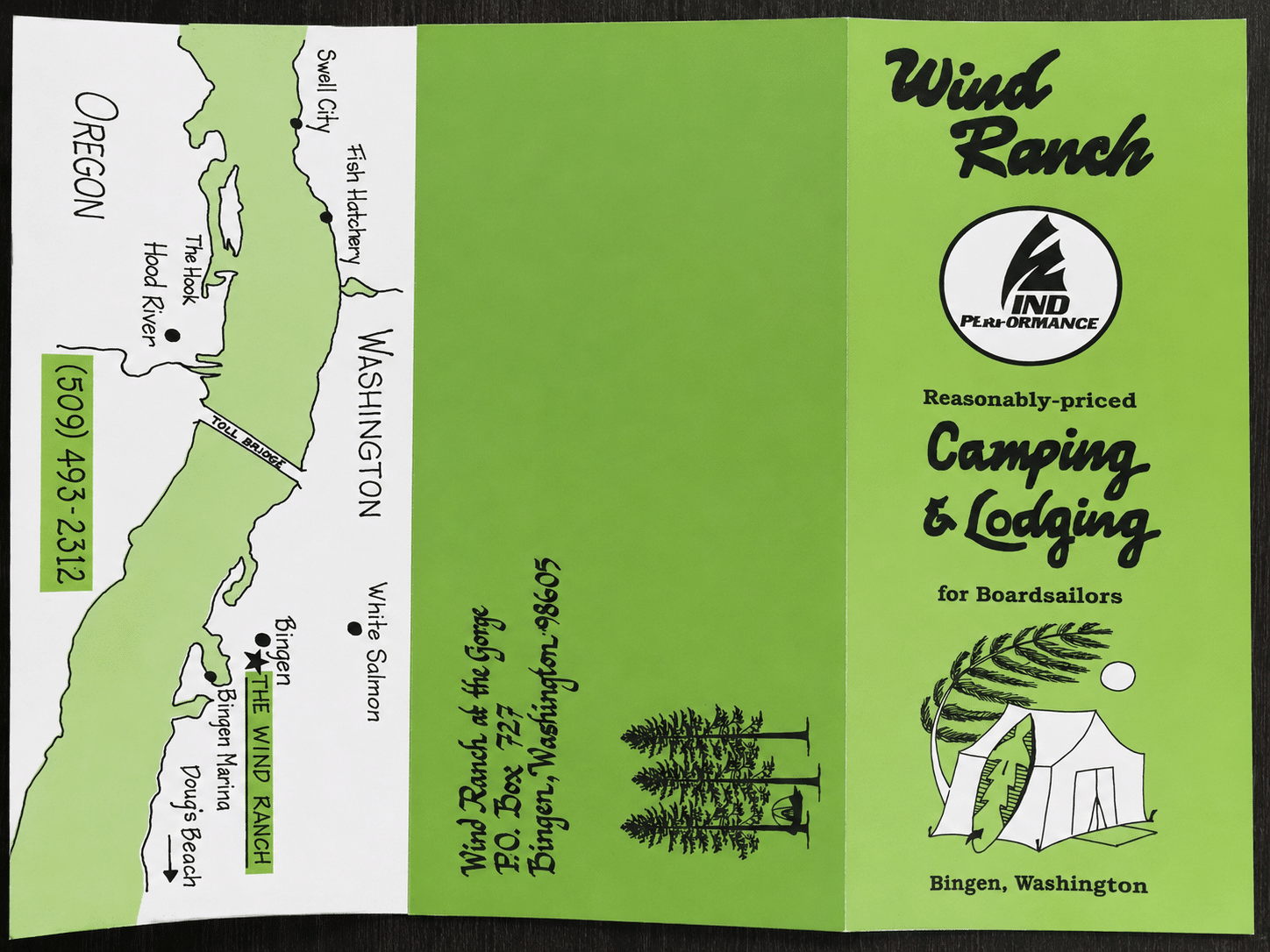
Carl Meinberg was the longtime owner and operator of the Wind Ranch campground in Bingen during the height of the Gorge windsurfing boom in the 1980s and early 1990s. The ranch became a home away from home for thousands of windsurfers from around the world, especially before Hood River developed the hotels, condos, and vacation rentals that exist today.

The campground was situated just across the Hood River, Oregon, bridge from the town of Hood River, Oregon, a tiny step-back-in-time, western-looking stagecoach era stopover that was taken over by a ton of windsurfing hippies from all over the world. In the 1980s, Hood River became the mecca of windsurfing outside of Hawaii and is still regarded as the world’s greatest windsurfing destination. But this one you could actually drive to!
Bruce Peterson, one of the original Gorge sailors, remembering the early days:
“It used to be our little secret. If we had 30 sails on the water in a given day, that was a huge turnout.” “Everybody sailed the same spots and everyone hung out in the same places. We were like one big family.
So we got the van loaded, and we were off.
Directions: from New Jersey, the road trip was simple. Take the Garden State Parkway north from Exit 137 to Route 80 West, 3,000-something miles to Hood River. Turn right, and you’re in Bingen! Simple.
Each summer we all planned a trip out west. Dave Sidun, Mark McGraw, Paul Mindich, Chris Yandow, Johnny Gatens, Barb and Dennis Dempsey, Sammy & Teddy were just a few Jerseyans who trekked out to the Wind Ranch, where some would actually become transplants, relocating to and becoming local residents of Hood River and White Salmon.
Now It’s Your Turn
Saving History – Telling Stories – Comment Below

One of the funny memories was that there was nothing like trading cans of tuna for some windsurfing parts out of the van. Heck, I didn’t do that anywhere else, not Baja, not Corpus Christie, not the Gulf Coast of Florida, and I lived in that van for two years!
So, this is where this story turns into your story. Tell us something you remember if you camped at the famed Wind Ranch in Bingen, WA. Let’s see where this goes. We’ll update this post as people begin commenting below or sharing photos, or we find something on the internet worth sharing.
Send in some old Photos of the Wind Ranch – We’ll add to the collection. Give us details though – year, people in photo – etc.
Submitted Photos:
Online Photo Collection - Camping at the Wind Ranch


Other Online Collections
Hoping to have enough photos of the Wind Ranch to someday donate to either of these organizations.


About the Author

Brooks Betz and his wife, Jill, founded Mr. Local History and the Mr. Local History project back in 2019. Born in Plainfield, New Jersey, and raised in Westfield, Brooks graduated from Westfield High School in 1980 and Bryant University (1984).
For over two decades, Brooks, along with his family, owned the Cranford Canoe Club (Cranford, NJ) in the 1960s through the 1990s. His father, Frank Betz, became one of the first Windsurfer dealers in 1972 and became close friends with the Schweitzer family, who invented the classic Windsurfer.
Brooks took the shop and made it one of the nation's most noted windsurfing shops in the 1980s. Today, Brooks is a researcher writing stories about his experiences and documenting the history of the great state of New Jersey.

Related Posts

Windsurfing On the Columbia River Gorge in the 80s
Views: 1,117 💬 Leave a Comment | View 0 CommentsBefore kiteboarding, before wing foiling, and before extreme sports filled television screens, there was windsurfing, and nowhere captured its spirit quite like the Columbia River Gorge. Throughout the 1980s, this remarkable…
Facebook Post 2019 – BINGEN BART’S WIND REPORT – conversation #53, recorded in Bart’s Vervloet’s office. Columbia Gorge Wind & Water Assoc. Hood River, OR
“The pleasure of wind forecasting. Remember the first rule: don’t leave wind to find wind…
The Wind Ranch, that was a whole subculture unto itself. There was a whole pile of people at the Wind Ranch that used to camp out up there. They’re still around here, decades later. A whole series of crazy people. Carl Meinberg. Pink Car Bob. Chris Anderson.
I remember owning The Gorge Surf Shop we used to do board repairs, fix booms, or re-grip booms for people at the shop in Bingen. We always had tools out for use. The sales counter was a work bench. Lot’s of time I’d deliver stuff to people up at the Wind Ranch, “I’m gonna be going sailing tomorrow, early. I’ll swing by your tent and drop off your repair…”
I’d be finished doing my wind report in the morning. It was always recorded by 6:30am, or quarter to seven. So I’d pick up the person’s boom, enroute to dawn patrol sailing at Doug’s, and zip over to the Wind Ranch. I’d drive into the Wind Ranch and all the radios were tuned in to the Wind Report, and I would hear my voice coming out of people’s tents, and out of their car windows while I’m driving around in there. Quadrophonic Stereo blasting from all sides, it was kinda weird.
That first winter I worked in the ski shop. That was the winter of 85-86. I did a lot of radio promotions, sale promotions, ski sales, that kind of stuff. The shop was called Ski Mart. So I met the people from Q104. In the spring of ’86 at the end of the ski season someone said, “Hey, how come there isn’t something for windsurfing? Like the ski report…?”
So we came up with the idea of doing the wind report. I did it in exchange for doing ad time, as a sponsor. Bart’s Best Bet sponsored by The Gorge Surf Shop. Then a whole batch of other businesses started advertising before or after to my radio report. That’s when it turned into a paycheck. It actually paid quite well. I’d worked out a good deal with them early.
I did that wind report for twenty-two years. 22 years! I took one year off when I was working in Europe, and Victor-the-Inflictor did the report for me. I phoned in the wind report each and every morning until whatever year it was, when the radio station Q104 was sold.
The license, Q104 station-broadcast-license was 100,000 Watts. They called it a ‘Super Station’. There aren’t too many small rural communities that have 100,000 watts. That’s as big as they come. At some point the FCC quit issuing 100,000 Watt Licenses. So if you had one, suddenly they became very valuable.
So all these big corporate interests started buying up small-area 100,000 Watt Licenses. And the company that bought the one from the Gorge, moved it to Olympia Washington. They broadcast north of the Puget Sound. It’s still called Q104, same numbers, everything. But its up there now.
Pink Car Bob, he did a did a bit of local wind reporting for KIHR. He would call in on his cellphone. Remember the pink Torino he had? With the teeth? That old Ford Torino with the roof cut off? It was bright pink. He was a ski racer in college, so he had all these ski banners for seat covers. Pink Bob with the classic Torino, with the big round toothy grill out front.
Anyway, met this lady at the radio station and it turned into the Wind Report. Seven days a week, from April through the end of September. Pressure gradients. For twenty-two years, unbelievable.
Wind. Sailing. The difference in the pressure gradients. That’s what makes the wind blow, right? I’d watch the barometer. Note the pressure differences. Watch the barometric pressure in Portland. I’d set my barometer on the wall, watch it. Where was it last night? Reset the needle. Watch to see if the pressure was changing one way or the other. Write down where it was the previous night.
I bought a MacSE for some RIDICULOUS amount of money. Just so I could get the gradients. When that information became available online, I could log into the weather stations through the National Weather Service. Get spot reports for barometric pressures from different areas. I’d be looking at those numbers from Portland, The Dalles, and Pendelton. Then we started looking at the south Oregon coast, and over to Spokane. Check the north-south gradients, because that seemed to affect what the wind in the desert was doing, or going to do tomorrow, or not do. Didn’t matter what it was this way, you had to have a little bit of that from over there, to make it really good in the Gorge. We started watching pressure patterns. And calling truckers.
I’d be calling truckers on my CB radio from my shop in Bingen to see if it was windy in Arlington. All the truckers come down that grade, and they’re looking right at the Columbia River.
I’d be asking, “Hey, are there any whitecaps out there? Some guy would answer, “Oh yeah, it’s real windy. Hard to keep my truck on the road!” Ok. Good to hear from you. Thanks a lot, have a nice day! (laughter)
Old Radio photographed at the Hood River Museum. July 7, 2018
SPROUTNOTE: I encourage everyone to support the CGW2 by joining, and/or donating, today!
CGW2 is a not-for-profit membership organization representing the interests of The Columbia Gorge Wind & Water Community. Dedicated to establishing and protecting safe and abundant access to the Columbia River for recreational water sports. For more info please contact Bart Vervloet