

At first glance, the Great Swamp seems peaceful, a quiet stretch of reeds, willows, and winding creeks lying between Basking Ridge, Harding, and Chatham. Yet beneath its still surface lies a story that spans thousands of years, from the melting of Ice Age glaciers to the whispers of ghosts that haunt its mists. Born from the retreat of ancient Lake Passaic, the Great Swamp became both a cradle of life and a keeper of secrets. Its dark waters have sheltered farmers, outcasts, and those known locally as the Swampers, families who once carved out a hard living along its soggy edges. Over time, the swamp gathered more than just history; it gathered legends. From the ghostly Lady of the Swamp and the Headless Hessian to the Devil said to stalk the shadows of the Devils Den, this landscape holds the soul of Basking Ridge itself, where nature, history, and the supernatural all seem to share the same breath.
History
Imagine standing on the quiet edge of the Great Swamp in Basking Ridge, where the boardwalks wind through cattails and silver maples. It is hard to picture that this flat expanse was once the bottom of a vast lake born from ice.
Thousands of years ago, during the end of the last Ice Age, enormous sheets of glacial ice covered northern New Jersey. As the climate warmed, the Wisconsin Glacier slowly retreated northward, leaving behind enormous blocks of ice and ridges of rocky debris. Meltwater pooled between those ridges, trapped in a natural basin. That basin became what we now call Lake Passaic, a sprawling, shimmering body of water stretching from Morristown through Chatham, Basking Ridge, and beyond.

Lake Passaic and the Passaic Valley- today we have the Great Swamp and the Passaic River, but the Passaic lake is gone.
Mr Local History
For thousands of years, the lake filled the valley. Melting glaciers, cold streams, and rainfall fed its waters. Ancient fish swam in its shallows. Along its shores, early forests of spruce and pine took root in the damp soil. But as the earth continued to warm, the natural dams of ice and sediment that held Lake Passaic began to erode. Water found new escape routes, first spilling through the Watchung ridges and then cutting a permanent outlet through what would become the Passaic River valley at Paterson’s Great Falls.
As the lake drained, it left behind a broad, fertile plain at its southern edge. Over thousands of years, the once deep lakebed turned into a wetland maze of ponds, creeks, and meadows. Sediment settled, peat and muck formed, and life adapted. What remained of the great glacial lake became a smaller, quieter world, the Great Swamp.
The swamp still breathes with the same rhythm shaped by ice and water. Every Spring and fall, it floods, storing the runoff that once filled Lake Passaic. Every summer it steams and hums with frogs and dragonflies, a reminder that nature always finds balance. The hills of Basking Ridge mark the ancient shoreline, and when you walk the trails of Lord Stirling Park, you are literally walking where the waves of a vanished Ice Age lake once touched the land.

Swamp Lands in Basking Ridge
Along the southern rim of the Great Swamp in Basking Ridge, the land tells a long story — one that begins with the dreams of a Revolutionary War general and winds through centuries of farming, flying, teaching, and conservation.
In the mid-1700s, William Alexander, Lord Stirling, a wealthy patriot and officer under George Washington, chose this low, fertile land for his estate. His manor sat where the wooded high ground met the open marshes. He built barns, workshops, and a fine home that locals called “The Buildings.” From there, Lord Stirling could look across the shimmering wetlands of what was once glacial Lake Passaic. After he died in 1783, the estate passed to new owners, but his name stayed tied to the land — today’s Lord Stirling Road and Lord Stirling Park trace his legacy.

For the next two centuries, the area changed little. Families farmed hay and grain on the dry edges and cut wood along the brooks. The swamp remained a wild and quiet place, a buffer between Bernards Township and the villages to the North. In the early 1900s, small dairy farms and tenant homes lined the road. During the 1930s, a flat meadow at the edge of the swamp became the Basking Ridge Airfield, where local pilots and flying clubs used a grass strip to test the new freedom of the skies. It later became known as Somerset Hills Airport, but by mid-century, aviation would threaten the swamp in a very different way.

In the late 1950s, the Port Authority of New York and New Jersey shocked the region with a plan to build a major international jetport right on the Great Swamp basin. The site would have leveled thousands of acres, displaced entire communities, and erased the natural wetlands that had existed since the Ice Age. The people of Basking Ridge, Harding, and surrounding towns rose in protest. Through tireless organizing, fundraising, and national attention, local citizens blocked the plan. They bought land, donated it to the federal government, and by 1960 their efforts succeeded: the Great Swamp National Wildlife Refuge was born. What might have become runways and terminals instead became one of America’s earliest and most important grassroots conservation victories.

In the decades that followed, the Basking Ridge edge of the swamp blossomed into a hub for education and stewardship. The Somerset County Park Commission established Lord Stirling Park to protect the floodplain, creating miles of trails and boardwalks through the forests and marshes. The Environmental Education Center, opened in 1977, became a regional model for public ecology and outdoor learning. Nearby, the Lord Stirling Stable opened with riding trails that let visitors explore the old meadows on horseback, following paths that once served as farm lanes and wagon tracks.
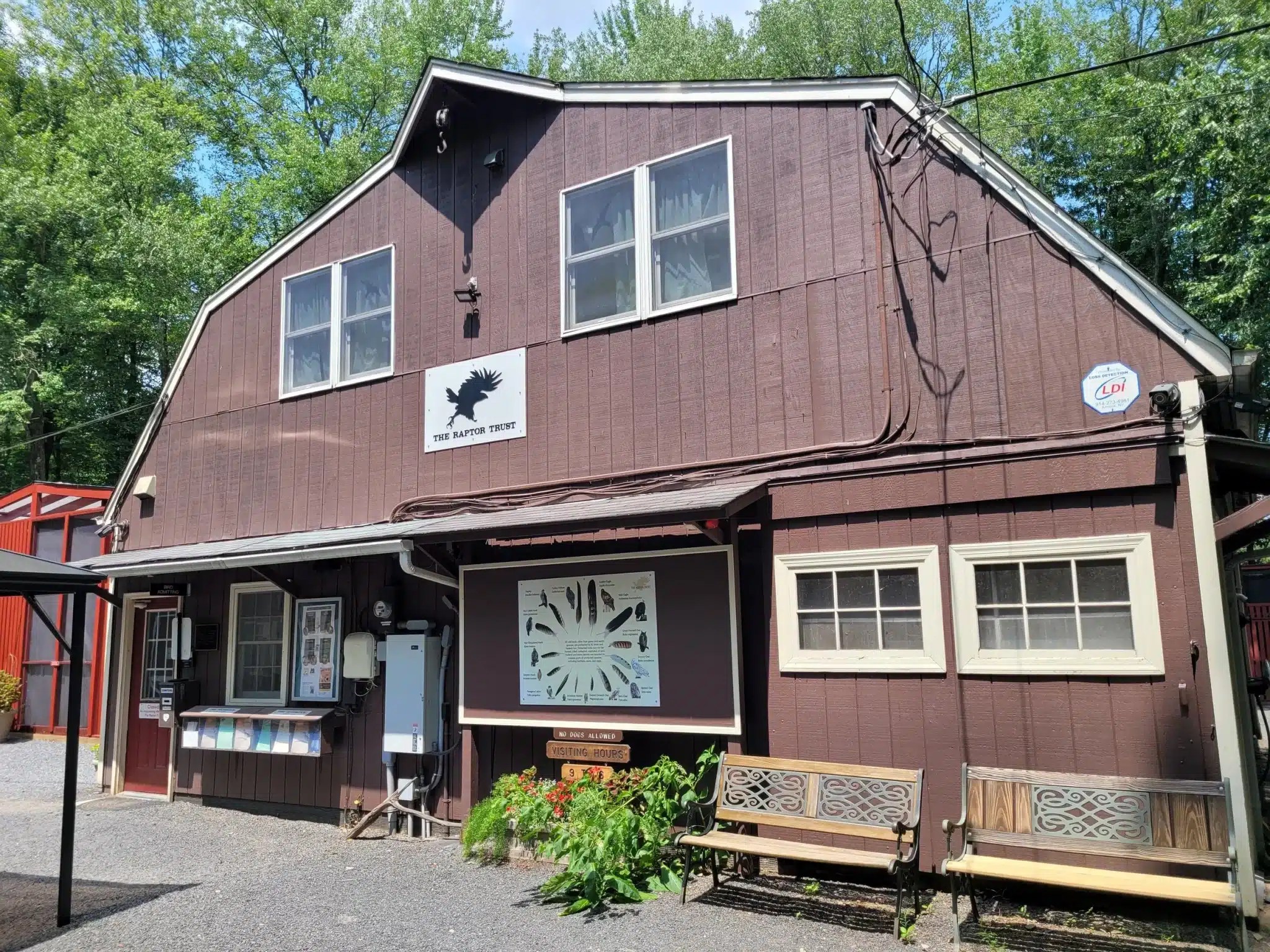
Not far away, a quiet act of compassion became another legacy. In 1968, Len and Diane Soucy began rescuing injured hawks and owls on their property near the refuge. Their backyard project grew into The Raptor Trust, one of the nation’s leading bird rehabilitation centers. Thousands of raptors have since been treated and released over the very swamp that once faced destruction.
The same stretch of road also became home to Lord Stirling School, a small, specialized educational program serving students with unique learning needs — another reflection of the community’s commitment to learning, care, and second chances.
One of the more surprising preservation stories of 2026 involves the former Lord Stirling School property in Basking Ridge. The site, where developers have long proposed constructing a senior housing complex, was recently included on New Jersey’s list of the state’s ten most endangered historic properties. For many local residents, the designation raises more questions than answers.

While the property has become the focus of a lengthy redevelopment debate, critics argue that the former school building itself has little architectural, historical, or cultural significance compared with many truly endangered historic sites across New Jersey. As a result, some view the listing not as an effort to preserve an important landmark but as another chapter in the ongoing controversy over the property’s future use.

Living in the Swamp
Today, when you drive along Lord Stirling Road, you pass through more than three hundred years of layered history: from the colonial ambitions of Lord Stirling, to the quiet resilience of local farmers, to the citizen victory that saved the swamp from becoming a jetport. The boardwalks, stables, and wildlife blinds of modern Basking Ridge stand as living proof that this place, once threatened by machines and progress, found a better destiny; one rooted in nature, history, and the enduring will of the people who refused to let it disappear.Evolution and the Swamp.
Around 1930, Bernards Township began to turn a corner. The old farm lanes and quiet hedgerows still framed the landscape, but new signals of modern life started to appear on the rim of the Great Swamp. On a flat meadow by South Maple and Lord Stirling Road, a grass strip became the local airfield, and weekend crowds came to watch taildraggers lift into the sky. A few miles away, the federal government opened the Lyons veterans campus, a self-contained village of care with red-brick wards and tree-lined walks. Trains still ran, and tractors still coughed across the fields, but the township had stepped into a different era.

After the war, the tempo quickened. New houses arrived along country roads, then on cul-de-sacs that curved with the land. The school district grew, the main streets got busier, and the old pattern of dairy and hay gave way to the suburban beat of car pools, Little League, and church suppers. In time, a corporate star rose on the northern horizon when a grand research and executive complex for the telephone giant took shape in Basking Ridge. The campus announced that the township was no longer just a bedroom community. It was a place where decisions were made, the kind of place that drew engineers, managers, and families from across the country.


Prosperity rolled across the uplands. New neighborhoods filled the ridges, and the farm stands gave way to office parks and preserved greenways. Yet down in the low ground by Lord Stirling Road, the cadence remained slower. The swamp that had once been the floor of a glacial lake refused to be hurried. It flooded in Spring, steamed in summer, and absorbed the rush of storms with the patient breath of wetlands. While subdivisions climbed the hills, the flats kept their hush. Boardwalks replaced wagon ruts. Songbirds reclaimed thickets where woodcutters once stacked cords. The Environmental Education Center opened its doors and showed schoolchildren how to read the lives of frogs and sedges. The county stables led riders through ferny corridors where the river bends. The Raptor Trust nursed hawks and owls back to health and sent them winging out over the reeds.
Swampers? (noun, local history)
There is Such a Term

Swampers
An informal nickname used in the Basking Ridge area of Bernards Township, New Jersey, for the small, close-knit families and laborers who once lived along Lord Stirling Road and in the western reaches of the Great Swamp before the area’s transformation into parkland and federal refuge in the 1960s.The term “Swampers”, sometimes coupled with the label “Appalachian hillbillies of the swamp”, was a colloquial, often derogatory, description used by outsiders to portray these residents as rustic, poor, or isolated. In reality, the Swampers were self-reliant people who made their living through small-scale farming, woodcutting, hunting, and day work on nearby estates. Their modest homesteads and outbuildings dotted the lowlands that later became Lord Stirling Park and the Great Swamp National Wildlife Refuge.
Usage:
“Old-timers still talk about the Basking Ridge Swampers: families who kept to themselves along Lord Stirling Road, long before the park boardwalks and wildlife blinds.”
By the early 1970s, nearly all of these homes had been removed through county and federal land acquisitions. Today, little physical trace remains, but we are trying to preserve their legacy as the final generation to inhabit the Basking Ridge side of the Great Swamp. These people lived “in the swamp before the swamp became famous.”

Horror Tales and Lore of the Great Swamp
Every October, people love to tell horror tales from the Great Swamp. Here are just a few we’ve told over the years, including the Lady of the Swamp, the Headless Hessian, and the Swamp Devil.

The Lady of the Swamp
Deep in the shadowy wetlands of Basking Ridge lived Matilda Greenleaf, a lonely herbalist whose cures worked a little too well for comfort. Feared as a witch, she was said to have made pacts with darker forces that protected her from harm. When a ghostly white deer began haunting the swamp, livestock fell ill, and fear gripped the farms. One man, driven by vengeance, forged silver bullets and tracked the creature to Matilda’s shack. Soon after, she was found dying, and the doctor who tended her claimed to have pulled three silver bullets from her spine. To this day, a white deer is said to wander the Great Swamp, its red eyes glowing in the fog, guarding the restless spirit of Matilda Greenleaf.
The Headless Hessian from the Swamp
Legend tells of a Hessian soldier who lost his head during a Revolutionary War skirmish near the Lord Stirling estate and was buried in the swamp’s black mud. Ever since, travelers near the Devil’s Den have heard the thunder of phantom hoofbeats and glimpsed a dark rider racing through the mist. He carries no head, only the glint of his saber under the moonlight. Some say Washington Irving borrowed this tale when he wrote of Sleepy Hollow’s horseman, and others believe the spirit still patrols the Great Swamp, searching for the head he lost centuries ago.
The Great Swamp Devil and the Devil’s Den
Just off White Bridge Road, beyond the ruins of an old church, lies a hollow known as the Devil’s Den. It is said to be a doorway into the darker heart of the Great Swamp, a place where even the wind hesitates. For more than a hundred years, people have spoken of a tall, hairy creature that prowls the marsh, shifting shape between man and beast. Its liquid red eyes glow in the night, and its footsteps echo in the fog. Some call it the Devil of the Swamp, a spirit left behind from the earliest days of the colonies, while others think it is something far older. Those who have felt its presence swear the air turns heavy and the trees seem to lean closer, as if the swamp itself is watching.

More History In and Around the Great Swamp

Stirling Manor – The 13 Colonies’ Most Prestigious Home was in Basking Ridge, New Jersey
Views: 3,518 💬 Leave a Comment | View 1 CommentIs William Alexander, aka The Earl & Lord of Stirling, Basking Ridge’s Most Famous Resident? Our researchers think so. Let’s see if we can answer that question. William Alexander (1726 –…

Millington’s Garden State Fireworks Lighting America’s Nights Since 1890
Views: 6,709 💬 Leave a Comment | View 0 CommentsLong Hill Township, in Morris County, is made up of the villages of Stirling, Millington, Gillette, Meyersville, and Homestead Park. Each village has its own unique character, with Stirling serving as…

The Somerset Hills Airport in Basking Ridge – Lost but Not Forgotten
Views: 16,591 💬 Leave a Comment | View 25 CommentsLord Stirling, the Revolutionary War Buildings, the First Airmail, World Record Gliders, the Tuskegee Airmen, the VA, a proposed Super Airport, and more historic moments tie back to this small strip…

That Historic Sand Pit in Basking Ridge, New Jersey
Views: 8,216 💬 Leave a Comment | View 9 CommentsIt’s been discussed over the years in hushed circles at Brush’s Deli. It has been described as a racing playground, a car junkyard, and a kids’ playground over the decades. Now…

Saving the Great Swamp- The Fight to Defeat the Jetport – Filmmaker Scott Morris
Views: 6,365 💬 Leave a Comment | View 0 CommentsDID YOU KNOW OVER A DOZEN JERSEY TOWNS WERE ALMOST LOST to a super-regional airport in the 1960s? The concept of an airport, which started at 10,000 acres, ballooned to 25,000–30,000 acres,…

Retrospective: Belcher- Moggy Hollow – Buck Gardens and the Far Hills Fairgrounds
The 12-acre locale in Far Hills, New Jersey, known as the J. Malcolm Belcher Fairgrounds, holds a significant place in local history. Named after James Malcolm Belcher, former mayor, WWII veteran, and influential community figure, the area now serves as…


