Just when you think you know everything about New Jersey, the state pulls another surprise from its seemingly bottomless bag of tricks. We already have ocean beaches, mountains, waterfalls, sprawling farms, colonial villages, busy cities, and some of America’s most famous boardwalks. What else could possibly be hiding here? Then you arrive at Lake Mohawk in Sparta and discover, of all things, another New Jersey boardwalk. But not just any boardwalk, a European-flavored, Disney-like boardwalk.

This one is not lined with amusement rides, flashing arcades or saltwater taffy shops. Instead, the Lake Mohawk Boardwalk curves along a peaceful mountain lake, surrounded by sailboats, old-world architecture, and the storybook buildings of White Deer Plaza. Restaurants overlook the water, people stroll along the shoreline, and the entire scene feels as though someone transported a European lakeside village into the hills of Sussex County.
It is one of those unexpected places that stops you for a moment and reminds you why New Jersey is so difficult to define. Just when you believe you have seen everything the state has to offer, Lake Mohawk appears, and once again, New Jersey proves that it really does have everything.
First – Build a Lake
Before there was a Lake Mohawk, this part of Sussex County was a broad stretch of farmland known as Brogden Meadow. In 1925, the Arthur D. Crane Company began acquiring the property with an ambitious plan to transform the valley into a private lake and resort community unlike anything else in New Jersey.
Construction began in 1926 under developer and designer Herbert L. Closs. Workers cleared the meadow and dammed the headwaters of the Wallkill River, slowly creating the lake that became the centerpiece of the new community. Lake Mohawk officially opened on June 26, 1927, although rising water continued to fill the valley into 1928.

Among those attending the dedication was Princess White Deer, whose given name was Esther Louise Georgette Deer. She was a celebrated Mohawk singer, dancer, and activist who had appeared in vaudeville, Broadway productions, and the Ziegfeld Follies. White Deer Plaza was named in her honor and became the heart of the new community.
Iconic Lakeside Boardwalk
The Lake Mohawk Boardwalk was not an afterthought. It was included in the original plans with White Deer Plaza, the sunken garden, shops, and country club. The original boardwalk was 30 feet wide and approximately 2,500 feet long, creating a grand waterfront promenade in the Sussex County hills.
Arthur D. Crane and Herbert L. Closs were designing more than a lake community. They were creating an experience. Winona Parkway was positioned so arriving visitors would descend toward White Deer Plaza and suddenly see the lake, boardwalk, and shoreline buildings. The plaza served as a ceremonial entrance and helped attract prospective property buyers.

The inspiration came from the romantic villages of northern Europe. Buildings were placed close together, with steep roofs, projecting gables, towers, and decorative details drawn from Tudor, English Cottage, and German Baronial architecture. The compact village was then paired with an open waterfront offering sweeping views of the lake and surrounding hills.
Its location is what makes it so uniquely New Jersey. Boardwalks were normally associated with ocean resorts, amusement rides, and crowded Shore towns. Lake Mohawk placed one beside a quiet inland lake surrounded by wooded hills and storybook architecture. It connected the shops, restaurants, and country club while providing a place to walk, gather, and admire the water.

The Lake Mohawk Boardwalk and adjoining White Deer Plaza feature an inviting collection of locally owned shops offering gourmet foods, candy, flowers, gifts, custom clothing, and artwork. Visitors can browse Garlic & Oil, Nutty Over Sweets, Onore Clothing, Bluet Flower Co., White Deer Liquor Store, and nearby Yippy Art.
In 1988, White Deer Plaza, the boardwalk, and country club were placed on the National Register of Historic Places for their importance to architecture, commerce, and community planning. Nearly a century later, the boardwalk still accomplishes exactly what its designers intended. It draws people toward the water and makes Lake Mohawk feel like somewhere far beyond New Jersey.

Area Dining Makes a Fun Day Out
Eating along the Lake Mohawk Boardwalk feels like dining in a European lakeside village without ever leaving New Jersey. With sailboats drifting across the water, historic Tudor-style buildings lining the plaza, and tables overlooking the lake, every meal comes with a view and an atmosphere unlike anywhere else in the state.
Visitors can expect a surprisingly varied dining scene packed into the walkable White Deer Plaza and Boardwalk area. Choices range from lakeside Italian food and pizza at Angeloni’s and Casa Mia to tacos at Bone Yard, breakfast and brunch at Lake House Cafe, historic pub fare at Krogh’s, and wood-grilled dishes at St. Moritz. For a more upscale dinner, Mohawk House is a short drive north. Dessert options include homemade ice cream at Alpine Creamery, cakes and baked treats from Pattycakes, and old-fashioned candy and novelty sweets at Nutty Over Sweets.

The Lake Mohawk Country Club
The Lake Mohawk Country Club at the end of the boardwalk is a private club that’s been part of the lake community almost as long as the lake itself. The magazine also gives a great look at the lake, the boardwalk, and the club.
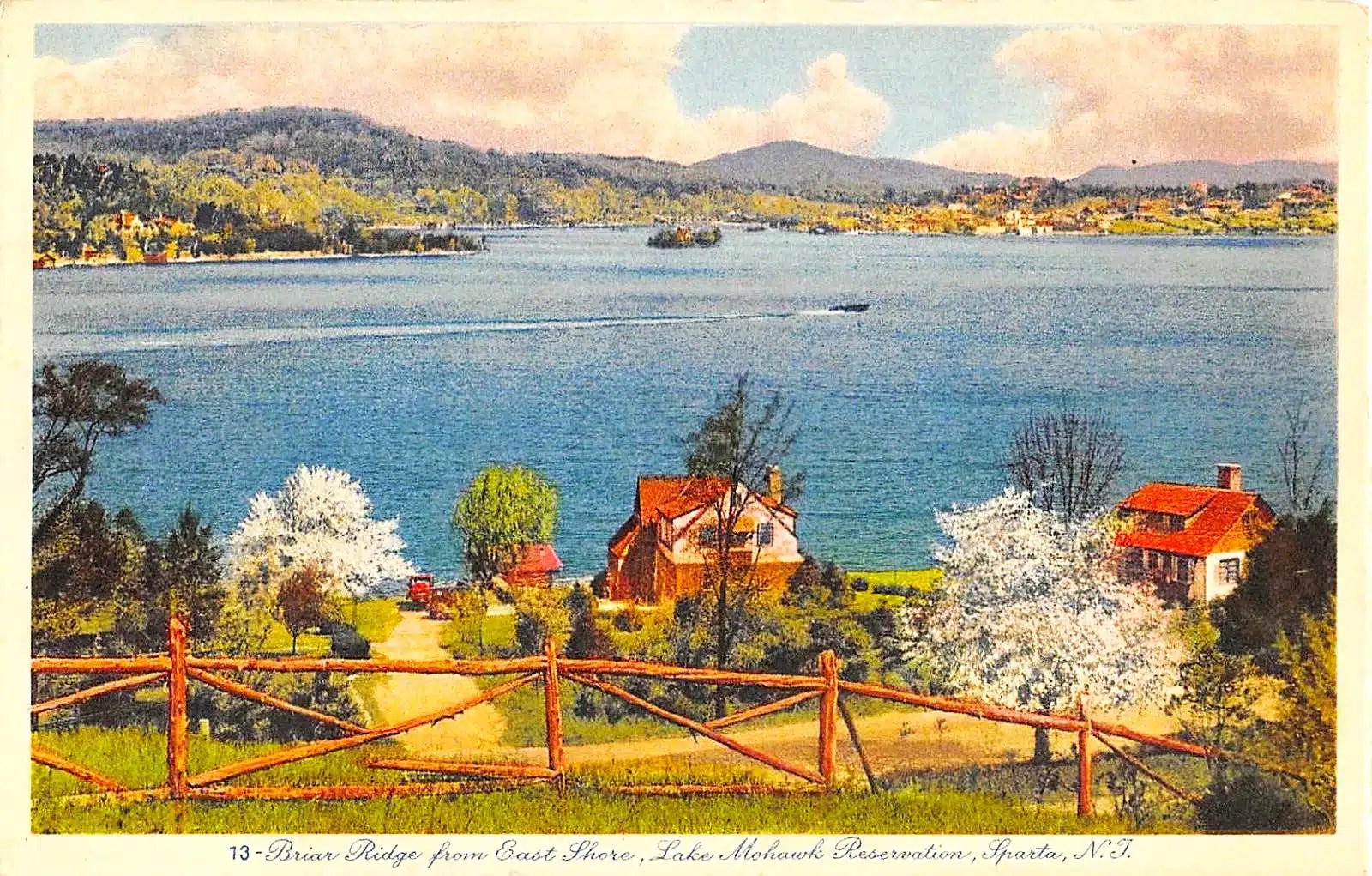
History with Postcards-
Our Historic Lake Mohawk Postcard Collection