


Yes, it’s true. While motorsports history has been kind to Daytona and Ormond Beach in Florida, historians often overlook that Cape May, New Jersey, rivaled Florida for the title of the world’s beach-racing capital. MLH digs in…..
Automobile racing on the beach began in 1902 in Ormond Beach, Florida, marking the notable start of NASCAR. However, the city’s famous connection with racing began in 1903 when the Winton Bullet won a Challenge Cup by two-tenths of a second against the Olds Pirate, putting the Daytona Beach area on the global automobile racing map. Did you know Cape May, New Jersey, was also a hotbed for beach racing as early as 1905? Read on.

New Jersey has a storied beach-racing tradition, including an epic 1-mile race in Cape May in the summer of 1905. The exhibition featured Henry Ford, Louis Chevrolet, and speed record holder Walter Christie. At the time, Cape May Beach was considered the “finest racing beach” in the world.


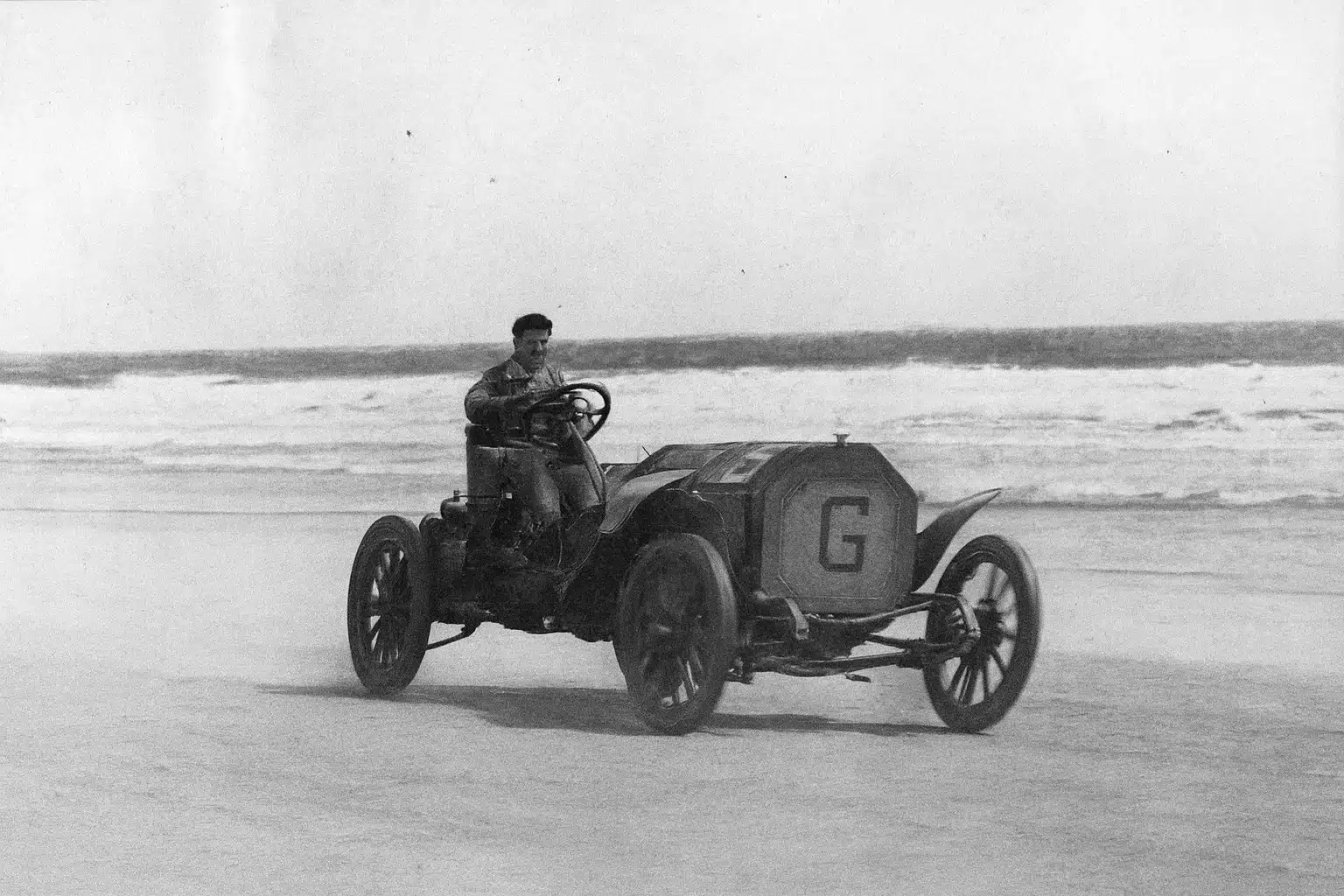

Cape May County Historical & Genealogical Society.
Only the famous Ormond Beach, Florida strip, was considered better than Cape May for racing new machines on the beach. All eyes were on Cape May on August 25, 1905, when Henry Ford, Louis Chevrolet, A. L. Campbell, Walter Christie, and 25 other drivers/machines came to race for two trophies. The Cape May Trophy would be awarded to the driver with the best time over a one-mile straightaway beach course. The other Cup ($500), the Kilometer Cup, would be awarded to the driver with the best time on the beach’s kilometer course. The race, scheduled for July 29, 1905, was postponed due to rain and held the following day. Christie won in his 8-cylinder, 180-hp Blue Flyer and took his machine around the course several times. In these heats, his times were very close to the record; in three heats, he ran 25.2 seconds at 90.72 mph. Finally, as spectators and officials watched, he was clocked at 25 seconds flat (89.28 mph), a new kilometer record. The later August races were run in subpar conditions, but as you can see below, traveling at over 90mph on a beach in 1905 was pretty impressive. Racers would move on to Atlantic City the following weekend.

1907 – The Atlantic City Automobile Carnival
By the summer of 1907, the roar of automobile engines was becoming a familiar sound along the New Jersey shoreline. Just a year after the celebrated automobile races on Cape May’s beaches, the excitement had moved north to Ventnor’s hard-packed sands, just outside Atlantic City. What had once been a novelty was rapidly becoming a serious sport, attracting daring drivers, powerful machines, automobile manufacturers, and thousands of curious spectators.

During the week of August 5–10, 1907, Atlantic City hosted its Automobile Carnival, an ambitious celebration of the rapidly growing automobile industry. The festivities included speed competitions on Ventnor Beach, an elaborate automobile parade along Pacific Avenue, and a three-day automobile exhibition at Young’s Pier. Organizers constructed spectator accommodations reportedly capable of seating more than 7,000 people, transforming the beachfront into a destination for some of America’s earliest automobile racing enthusiasts.

Imagine standing along the Ventnor shoreline that August morning. The ocean breeze carried the smell of saltwater and gasoline. Spectators gathered near the grandstands as mechanics made their final adjustments to the powerful, open-bodied automobiles. No modern safety barriers, enclosed cockpits, or sophisticated racing equipment. Drivers sat exposed to the elements, gripping oversized steering wheels while their machines bounced across the sand. The beach itself became the racetrack, with the Atlantic Ocean providing a spectacular backdrop.

Harry Cook, chairman of the Atlantic City Automobile Club, explained that the track would be wider “this year” because beach accumulation during the preceding winter and spring had widened it.
The course was one-mile flying-start events, and its entry list specifically refers to the “beach track.” The two-mile length likely provided room for acceleration, the timed mile, and slowing down,
Among the competitors was Guy Vaughn, a talented early automobile racer driving a Stearns, one of the period’s respected American automobile marques. On August 5, 1907, Vaughn won two races at Ventnor Beach: a gasoline runabout competition and a touring-car race for automobiles valued under $5,000. It was an impressive performance at a time when automobile racing was still finding its identity.

But perhaps the most remarkable connection to that summer survives not in a newspaper or photograph, but in a silver-plated trophy. Nearly 120 years later, a collector uncovered an original trophy bearing the beautiful winged-wheel emblem of the Atlantic City Automobile Carnival. Its ornate design featured a spoked automobile wheel surrounded by a decorative wreath, topped by a winged figure.


For the 1907 Atlantic City Automobile Carnival, organizers commissioned an impressive collection of silver and copper trophy cups to honor winners of 16 scheduled automobile races on Ventnor Beach. Bailey, Banks & Biddle, the prestigious Philadelphia jewelry and silverware firm, supplied the trophies, which were described as among the finest and most valuable prizes ever offered at an American automobile carnival. Before racing began on August 5, 1907, the trophies were proudly displayed in the windows of the Bell-Smith Company on Atlantic City’s famous Boardwalk, attracting considerable attention from visitors eager to admire the awards that would soon be presented to the victorious drivers. Photos from Mark E Gunsalus on Facebook. Thanks, Mark!
Engraved into the metal were the words:
OWNERS HANDICAP
OPEN TO ALL
OWNERS TO DRIVE
WON BY GUY VAUGHN
“STEARNS”
TIME 1.22
The inscription on Guy Vaughn’s trophy commemorates his victory in an “Owners Handicap” race on Ventnor Beach. Driving a Stearns gas automobile, Vaughn recorded a time of 1 minute, 22 seconds. The event required owners to drive their own cars, with handicaps helping balance differences in performance. The surviving silver trophy captures an exciting chapter in early American automobile racing.

The inscription offers a fascinating glimpse into the early days of automobile competition, when some events required the owners to drive themselves. Racing was not yet the highly specialized profession it would become. Wealthy automobile enthusiasts, manufacturers, mechanics, and adventurous drivers all helped shape the sport.
The trophy’s recorded winning time of one minute and 22 seconds remains something of a historical puzzle. Although racing records confirm Vaughn’s two victories on August 5, researchers have not yet established which specific competition produced this award. It may have been one of those races or another event on the Carnival program.
The racing itself was no small undertaking. Contemporary reports described a straightaway beach course, substantial grandstand facilities, and an automobile celebration that drew attention well beyond the Jersey Shore. Powerful machines were already reaching extraordinary speeds on these stretches of packed sand, years before purpose-built racing facilities became the standard.
And Guy Vaughn’s story didn’t end at Ventnor. Just five days after his victories, he was competing successfully again at Brighton Beach, New York. By 1909, his name was appearing in accounts of major American automobile racing developments, including the emerging Indianapolis Motor Speedway.

Today, the grandstands are gone, the racing crowds have disappeared, and the beaches have returned to their familiar role as summer vacation spots. Yet that surviving silver-plated trophy offers a remarkable connection to a forgotten chapter of New Jersey history.
From Cape May in 1905 to Ventnor Beach in 1907, the Jersey Shore was more than a summer playground. For a brief but exciting period, its beaches were among the proving grounds where American automobile racing was coming of age.
And How Can We Forget Ormond Beach (Daytona Beach) – Called the Birthplace of Racing
American Automobile Association Racing on the Beach, 1905, Ormond Beach, Florida. The area is now known as the “Birthplace of Speed.”
TROG Brings Auto and Motorcycle Racing
Back to the Beaches of New Jersey

Wildwood, New Jersey – TROG brings beach racing back to the Jersey beach the first weekend in October… lots of Dirty Rock and Roll… Night Of The Troglodytes, and lots more!
https://www.facebook.com/theraceofgentlemen/
Known as The Race of Gentlemen, the event has been revived since the 1950s by a local club called the Oilers of New Jersey. For one weekend in early October, racers, gassers, and fans gather on the beach in Wildwood, New Jersey, for one of only a few beach racing events in the United States. The Mr. Local History Project looks at this iconic event and its history.
Tucked between the Atlantic Ocean and one of America’s most popular boardwalks, the smells of cheesesteaks, French fries, and pizza mix with gasoline, roller coasters, water parks, and balloon games to give The Race of Gentlemen, a three-day motorsports festival on the Wildwood beach, a carnival feel.

Almost 15,000 people make their way to Wildwood, New Jersey, America’s doo-wop capital, to compete or cheer, not necessarily for any particular driver, but for the sheer joy of racing on a beach. Sponsored by Oiler’s Car Club of New Jersey and revived over the past decade by Mel Stultz, Michael Kliman, Tom Larusso, and about six others, it continues the tradition of Jersey beach racing dating back to the 1800s.
The inaugural Race of Gentlemen took place in 2012 on the beach in Asbury Park, NJ, just days before Hurricane Sandy made landfall. After the inaugural TROG event in Asbury Park, Wildwood, New Jersey, became the event’s home. The move 100 miles south was necessary because Super Storm Sandy destroyed the Asbury Park beach.

More MLH Jersey Motorsports Posts
- Ford vs. Chevy on the Beach in Cape May (1905)
- 1909 Racing on the Beach in Cape May
- Mr Local History Cool Motorsports Articles
- Weird NJ introduces TROG
- Inside The Cornwall Wall of Death
- Tuffy the Terror Lion and the Wildwood Wall of Death
- Rhett Rotten’s Wall of Death Returns to Brooklyn (2021)
- TROG official website
- TROG Facebook Page
- TROG Instagram Page


