Rufus Miller Header
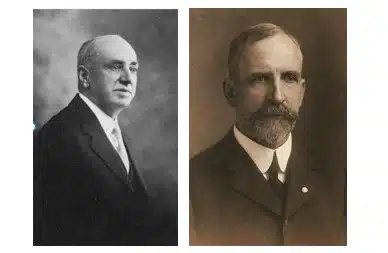
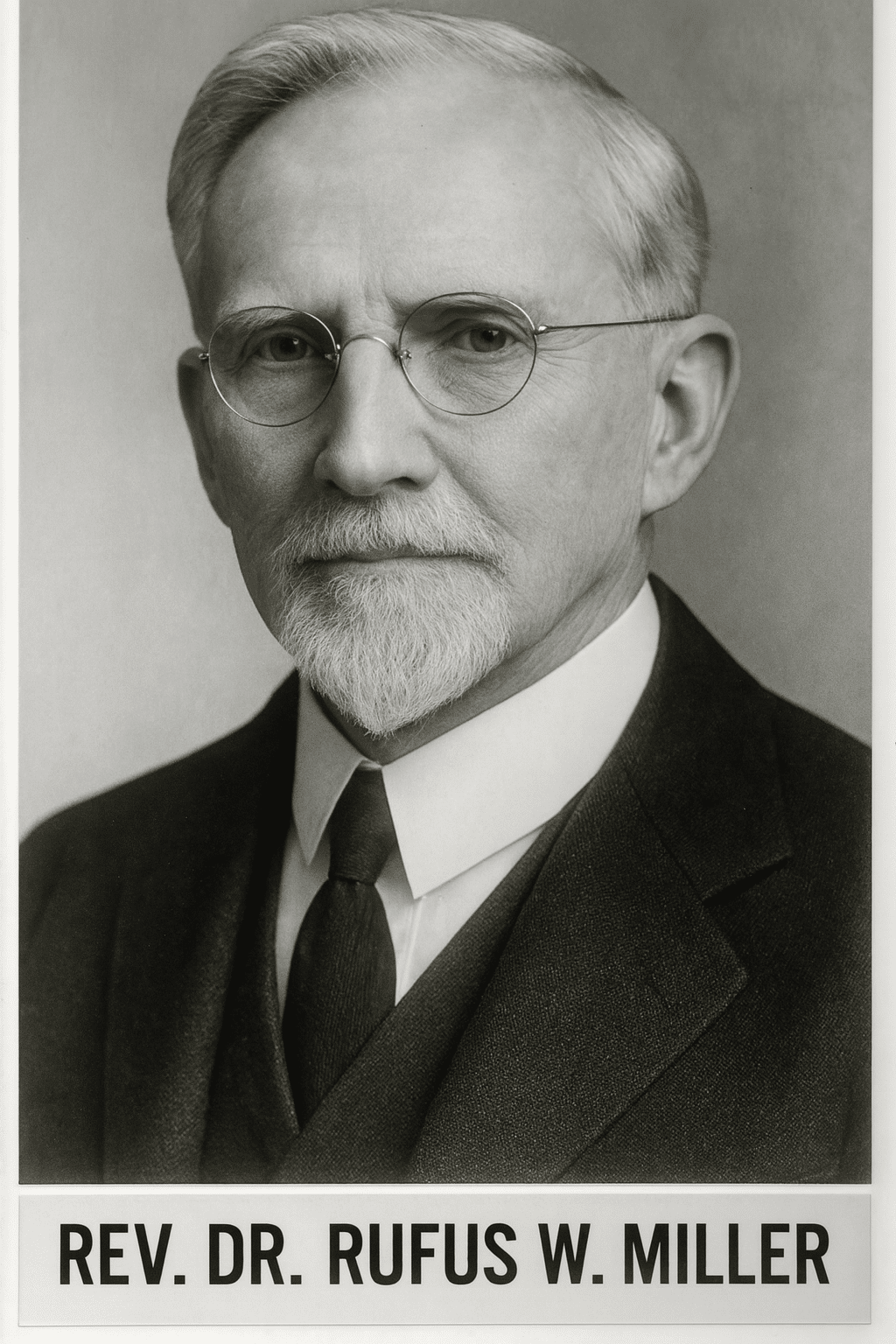
In the early 1900s, the quiet mountain community of Pocono Pines found its voice through the vision of Rev. Rufus W. Miller, a learned clergyman whose passion for education and spiritual fellowship reshaped the lakeside village. A genuine minister and a man of considerable organizational skill, Miller founded the Naomi Pines Assembly and Summer School in 1902, bringing the Chautauqua ideal of cultural enrichment and non-denominational worship to the Poconos. Under his guidance, Pocono Pines transformed into a seasonal hub of lectures, concerts, and lakeside gatherings, an ambitious blend of faith, learning, and recreation that left a lasting mark on the community’s identity.
This story is part of a series I’ve been researching, as I rebuild my memories growing up on Lake Naomi in the Poconos. As the series comes together, there is an associated Facebook Group, called Lake Naomi Memories, for anyone to share their memories that help create a digital history footprint on the web. Oh, and they’ll certainly help me remember as well.
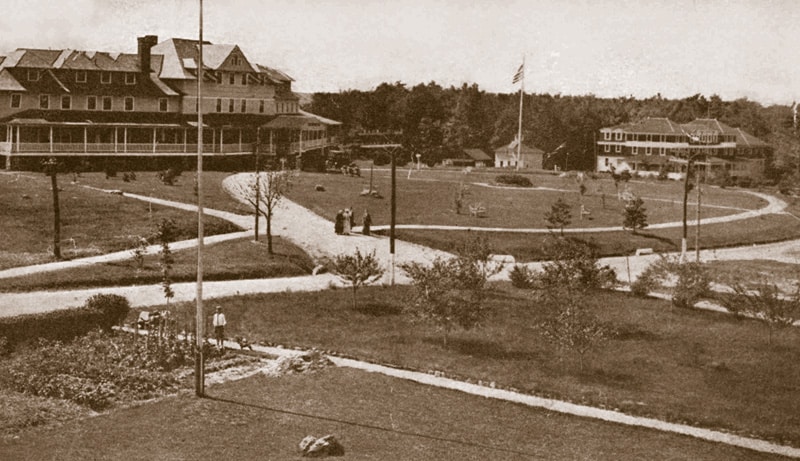
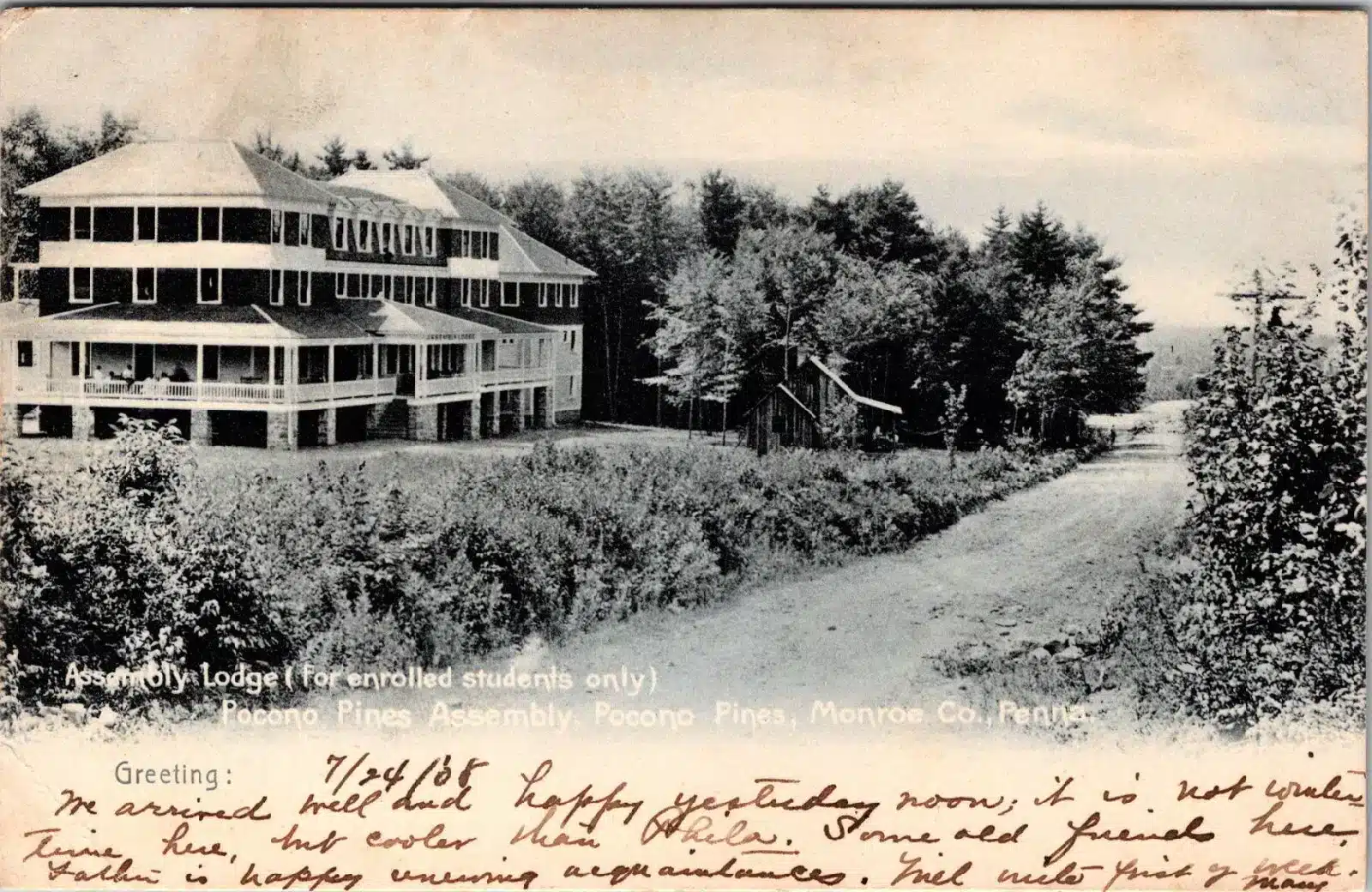
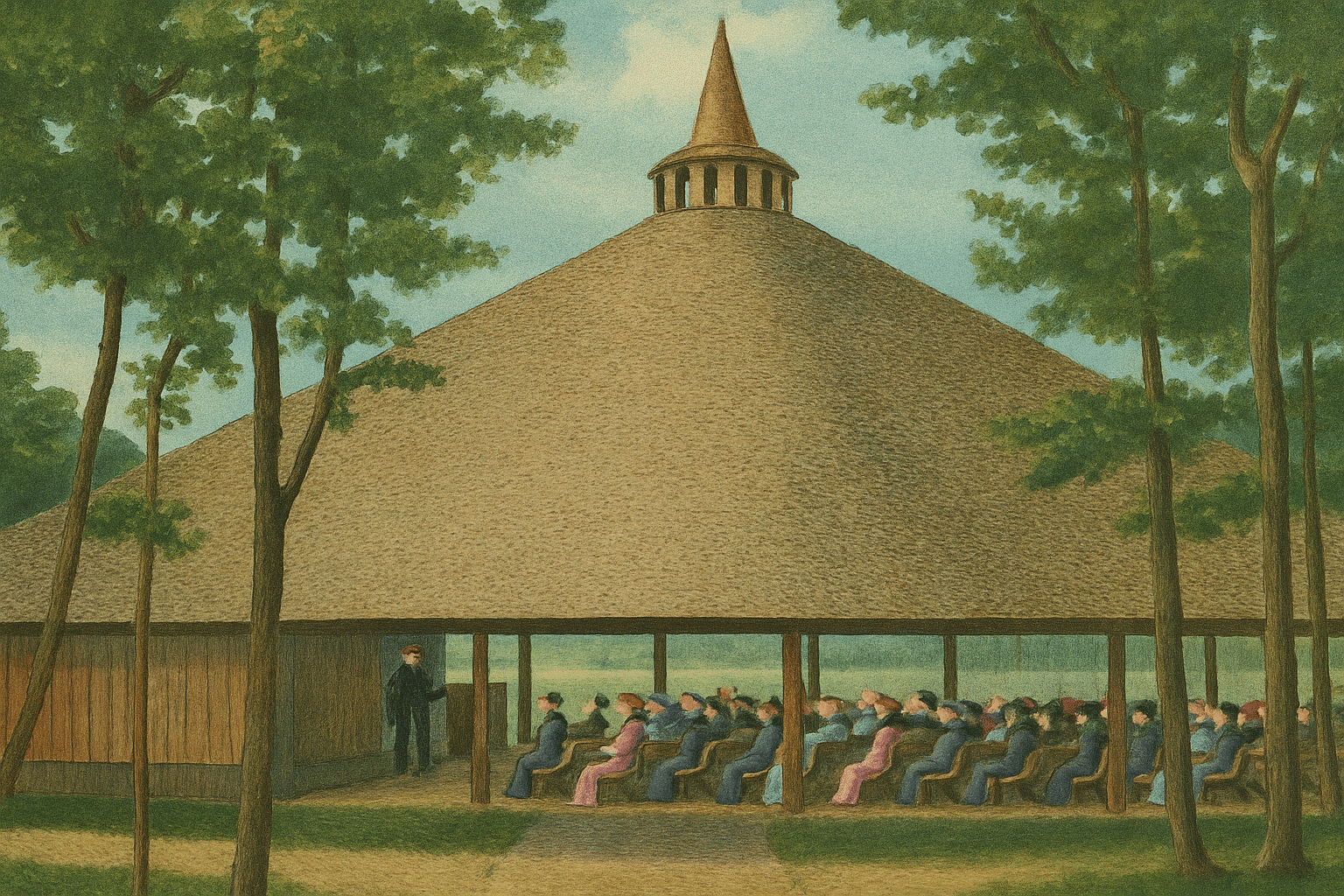
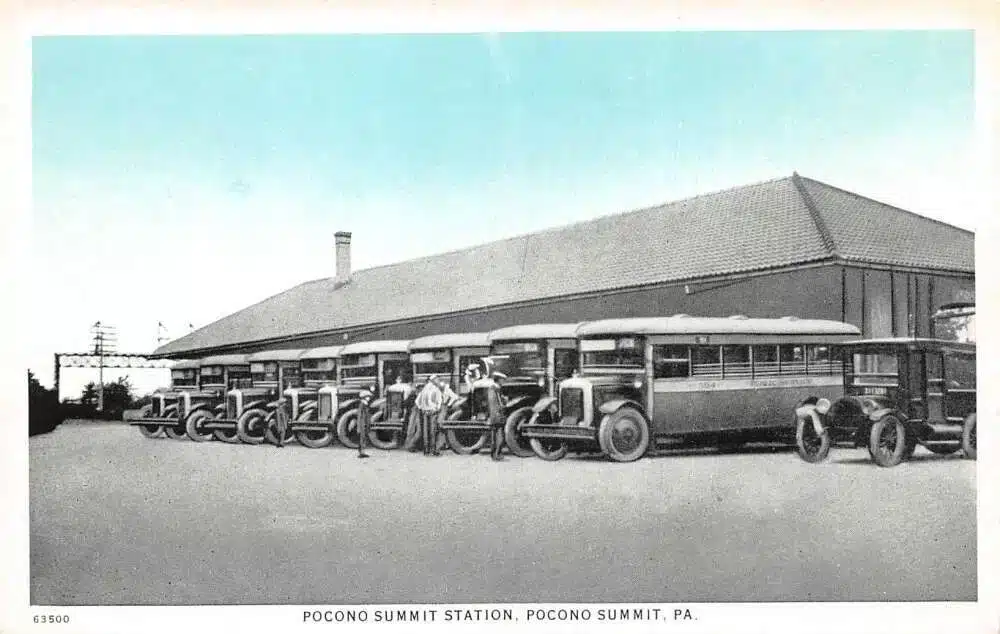
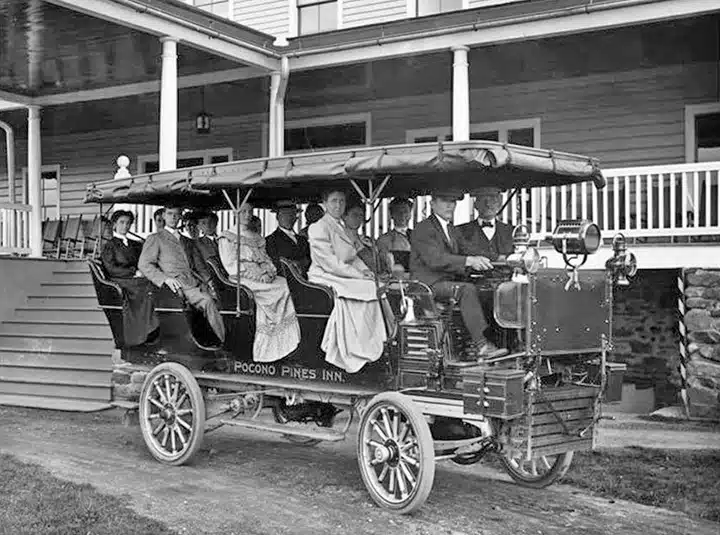
Community Impact: The Naomi Pines Assembly and Summer Schools opened in the summer of 1903 and included facilities like the Pocono Pines Inn, Blakeslee Hall, and an open-air auditorium overlooking Lake Naomi
History can be unkind, and this is one of those stories. As a younger brother myself, I can imagine how Rufus must have felt. His older brother, Franklin Comfort Miller, has long been celebrated. Franklin was born just two years earlier, and his name is everywhere; his daughter Naomi gave Lake Naomi its name, and there’s even an island on the lake that honors him: Franklin “Comfort” Miller Island.
But what about Rufus? His life and legacy are often overshadowed, yet he has a remarkable story of his own. Let’s dig in.
Thomas H. Miller and Emma were long-time Easton residents in Northampton County, PA. Franklin, Rufus’s older brother, was born on December 1, 1855. Three years later, Thomas, the brother, was born. But this story is about Rufus, and six years after Franklin, on May 9, 1862, in Easton, PA, Rufus W. Miller was born. Miller also had a younger sister, Florence Emma Miller, born three years after Rufus in 1865. All were born in Easton, PA.
So I first started digging like I always do and went to Ancestry.com to build a Miller family tree. Here’s what Ancestry says about Rufus:
When Rufus Wilder Miller was born on May 9, 1862, in Easton, Pennsylvania, his father, Thomas, was 37 and his mother, Emma, was 33. He had three brothers and three sisters. He died on October 11, 1925, at the age of 63.
See what I mean? No fluff there. But there is a story!
Around the early 1890s, Rufus and Franklin Miller began acquiring land in what was then called the Pocono Pines. In 1895, they dammed Tunkhannock Creek to create Lake Naomi for ice harvesting under the Pocono Spring Water Ice Company. I haven’t found any indication that Thomas or Emma ever fully moved from Easton to Pocono Pines. It’s more likely they visited for extended stays, especially during the ice season or summer, and maintained their primary home in Easton. Rufus himself split his time between Philadelphia, where he served as a minister and educator, and the Poconos, where he had property.
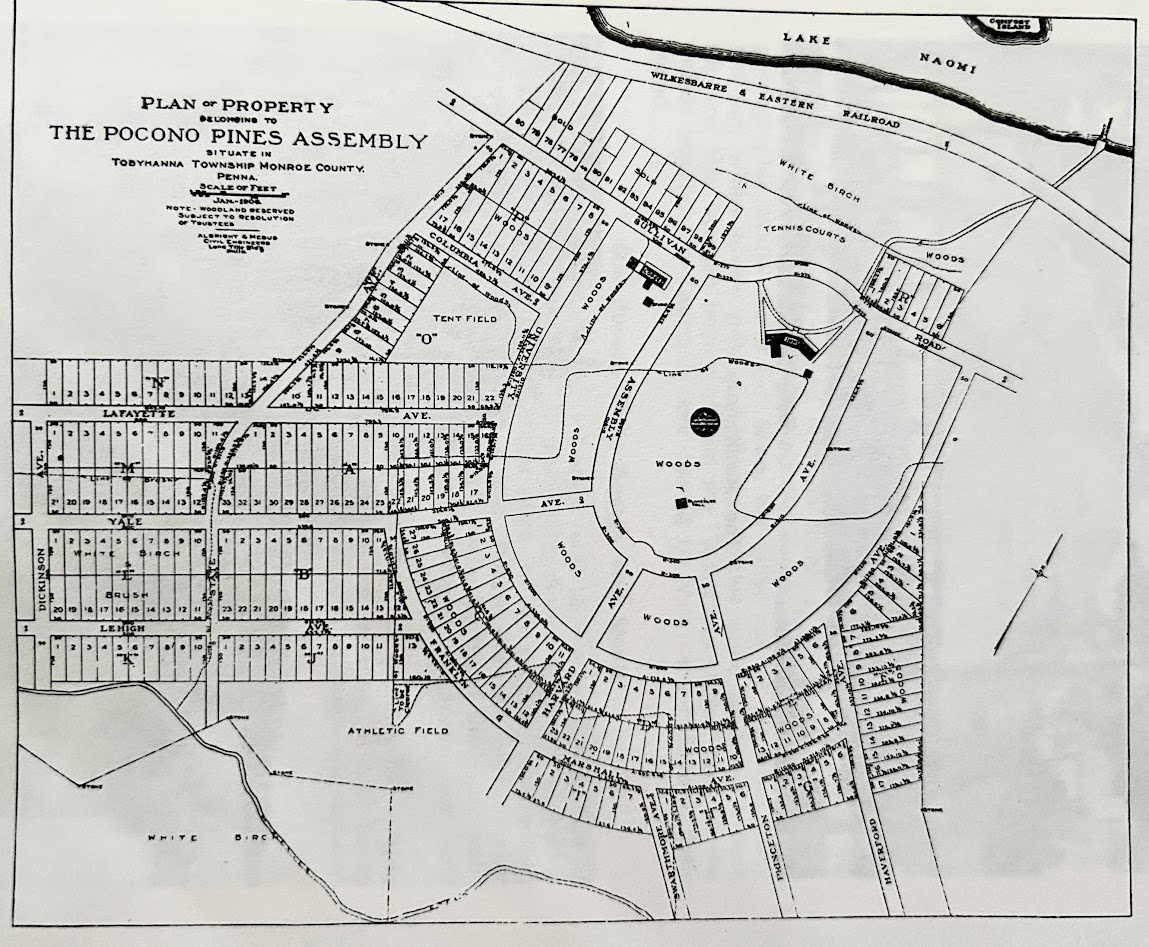
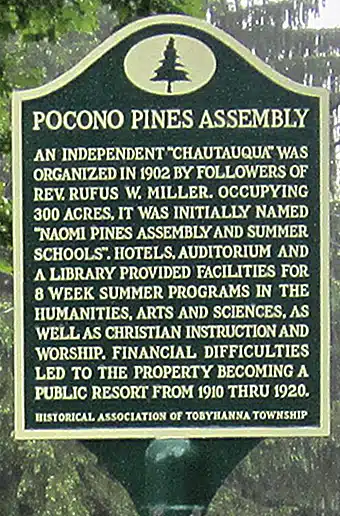
In 1874, on the shores of Chautauqua Lake in New York, a gathering intended to train Sunday school teachers evolved into something much larger. Under the leadership of John Heyl Vincent and Lewis Miller, the Chautauqua movement emerged, a blend of school, revival, and summer festival that combined lectures, music, art, and recreation in scenic settings. The idea swept the nation, inspiring permanent assemblies and traveling “tent Chautauquas.” In 1902, Rev. Rufus W. Miller brought it to the Pocono Mountains, creating the Naomi Pines Assembly and Summer Schools on 300 wooded acres. For eight summer weeks, guests filled hotels and the auditorium, studying, performing, and worshipping beneath the pines.
Dr. Miller had numerous religious affiliations. He was one of the founders of the Brotherhood of Andrew and Philip, a church organization for men; a member of the International Council of Religious Education; a trustee of the United Society of Christian Endeavor; and a member of the executive and administrative committees of the Federal Council of Churches of Christ in America. In 1909, Dr. Miller was elected president of the Eastern Synod of the Reformed Church and has since served as a member of the joint committee on Union between Presbyterian and Reformed Churches. He was president of the Pennsylvania Bible Society, a member of the International Sunday School executive committee, and vice president and director of the Parkway Trust Company of this city. Katherine McCauley 1888.
In 1902, Rev. Rufus W. Miller would purchase 300 acres of land near the quiet village of Pocono Pines, Pennsylvania. His dream was to create a local chapter of the Chautauqua movement, a phenomenon sweeping the country. These were more than summer retreats; they were gatherings where mind, spirit, and body could all be nourished. Remember now, this was almost ten years after they acquired land with their older brother Frank to dam the Tunkhannock Creek and start an ice company on a lake they had created. And yes, they got sued for doing it! (Another history story at the end of this one.)
POCONO PINES ASSEMBLY
Historical Association of Tobyhanna Township
In the early years of the 20th century, the Pocono woods came alive each summer with the hum of conversation, the swell of hymns, and the cadence of learned voices. Dr. Rufus W. Miller was ordained to the ministry of the Reformed Church in September 1886 at Reading, Pennsylvania. Immediately after his ordination, he became associate pastor of the Second Reformed Church in Reading, where he served until 1892. The Pocono Pines Assembly served as a religious and educational gathering place, with non-denominational Christian worship at its core. On May 9, 1888, Dr. Miller was married to his first wife, Katherine McCauley, also from Reading, PA.
The retreat was named the Naomi Pines Assembly and Summer Schools. From June to August, the place underwent a transformation. Hotels and cottages bustled with visitors. The grand auditorium rang with lectures on history, science, literature, and the arts. Morning Bible studies gave way to afternoon painting classes or orchestra rehearsals, and in the evenings, the grounds glowed with lantern light as people strolled under the pines after a stirring performance.
It was a community of ideas and inspiration, a place where city dwellers and small-town folk alike could escape the heat, breathe the mountain air, and return home a little wiser, a little more renewed.
But dreams like these were fragile. By 1910, financial difficulties began to shadow the Assembly. Attendance dwindled, and the costs of maintaining hotels, libraries, and lecture halls proved too steep. The lofty vision of a permanent cultural and spiritual haven gave way to practicality: the grounds were converted into a public resort. From 1910 to 1920, the Pocono Pines Assembly underwent a transformation, shifting from a temple of ideas to a playground in the mountains.
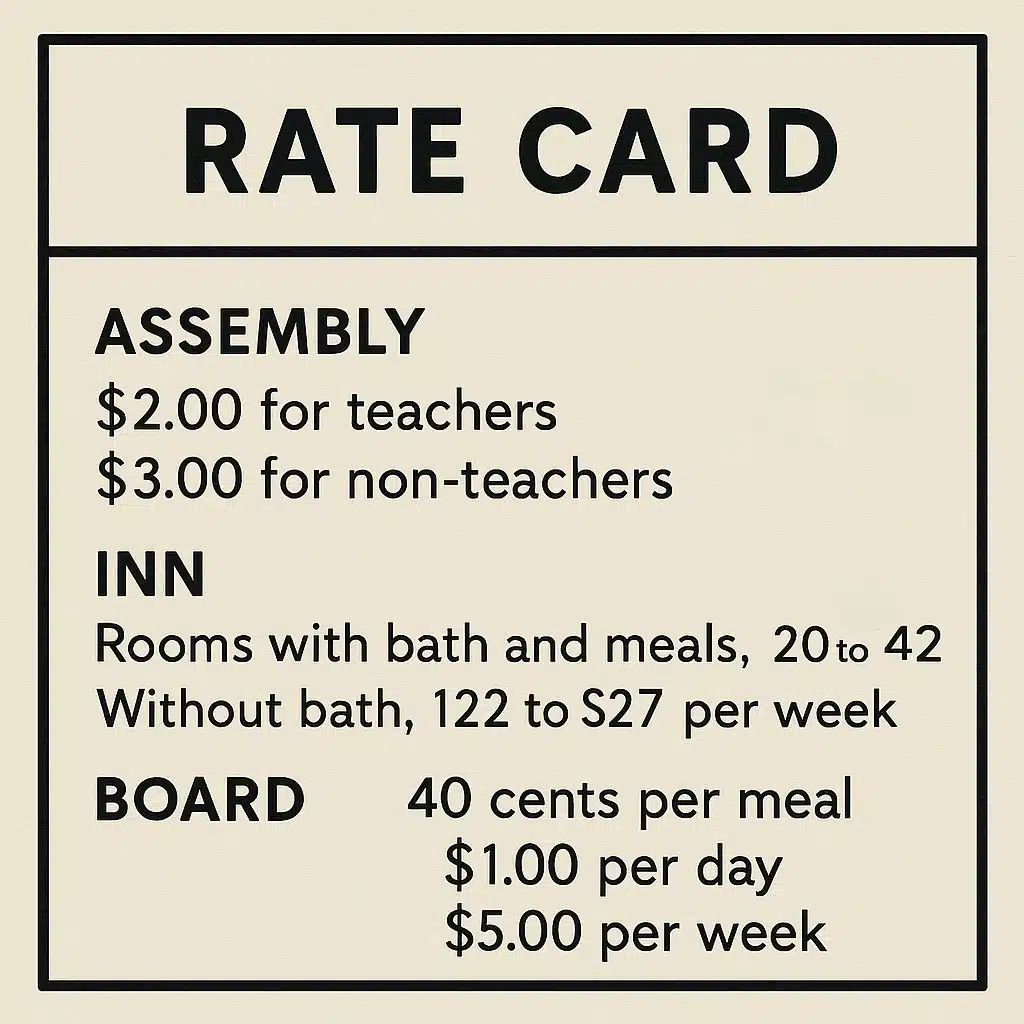
After the Assembly concept collapsed around 1910 due to financial strain, the site transitioned into a public resort. Instead of being run as a cultural-educational summer program, the grounds were marketed for leisure vacations. The main hotel, which had once housed Assembly guests, was upgraded and expanded for resort use, and in time it became formally identified as the Pocono Pines Inn, serving visitors for decades afterward.
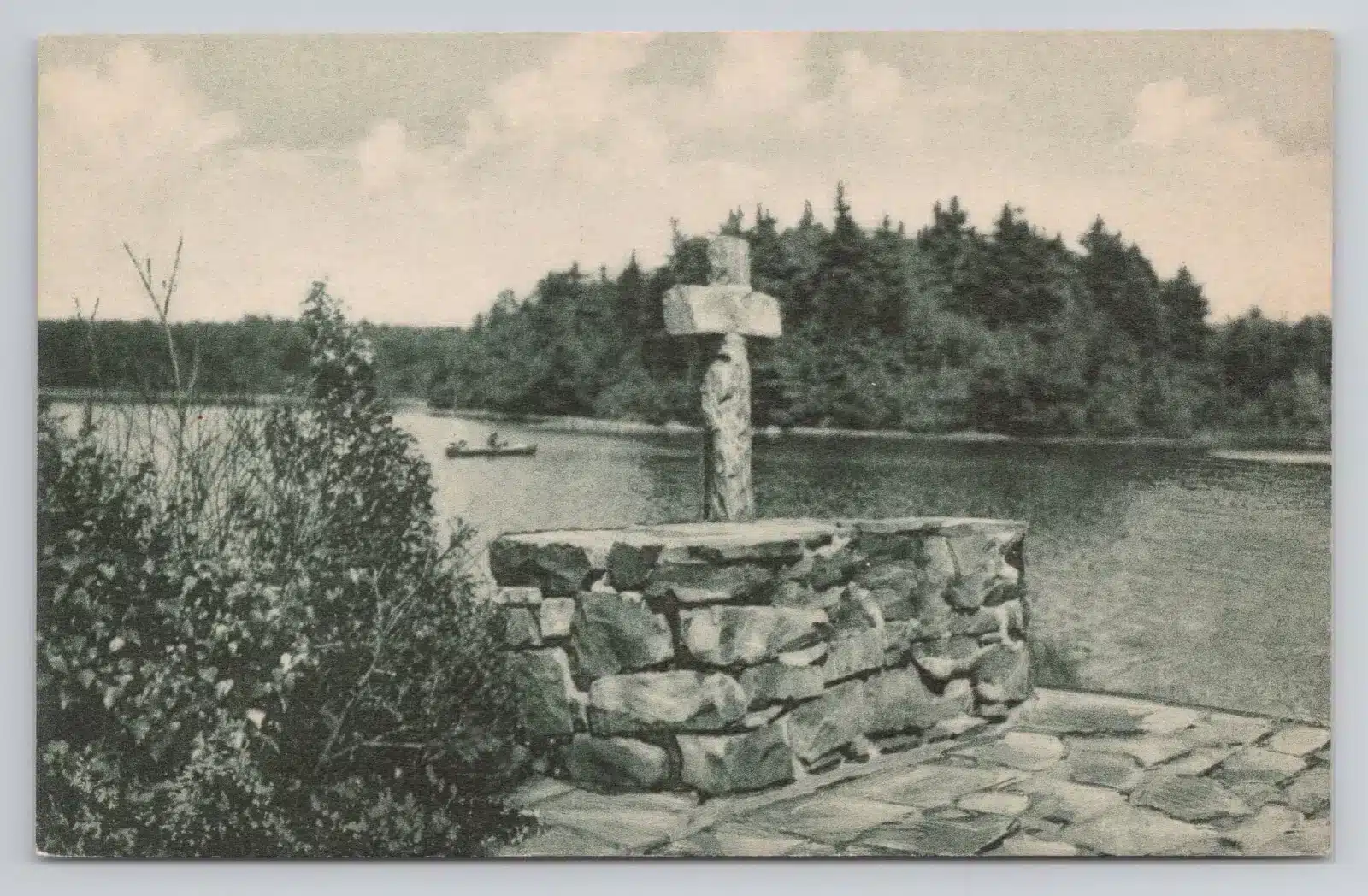
One thing I noticed during my research was a vast collection of postcards representing the beauty of The Assembly. Back in the early 1900s, you could get a postcard for a penny and write about your travels for anyone to see when it was in their mailbox. It was a really big deal back then, and it also serves as a great history lesson and research tool today.
Below is a collection of cards that students and guests wrote about their visit to the Pocono Mountains. I got to learn so much about what was really the Pocono Pines first, and one of the finest historical destinations in the area. You can click any postcard to begin a slideshow of enlarged images.
I’ve also put together a larger collection of all of my postcards I’ve gathered (See story).
Rufus would pass on October 11, 1925, in Philadelphia, Pennsylvania, at the age of 63. He was laid to rest at Easton Cemetery in his hometown of Easton. The next year, in August 1926, a deal was finalized with the Miller estate for the sale and transfer of Rufus Miller’s property in Pocono Pines to the Lutheran Conference and Camp Association (LCCA) for a planned Pocono Mountain community promoted by New York and Philadelphia Lutherans. The agreement, managed by the Stroudsburg Realty Company, added ,000 worth of land to the project. Lutherland already had 1,700 lots leased for 99 years, with leaseholders required to build homes on them. Plans included a 400-student missionary training college, a nearly 200-acre lake formed by damming Beaver Creek, and a vision to match Stroudsburg in building count within three years. The development encompassed 1,456 acres, combining Miller’s 116 acres, 300 acres from the former Pocono Pines Assembly, and 1,040 acres from Frank Meckes. Lutherland aimed to operate as a self-sufficient city with its own governance and finances. Check out our Pocono’s Gilded Age story.
By the mid-20th century, tastes in tourism began to change. Large summer hotels struggled as travelers shifted toward motels, motor lodges, and, later, private vacation homes. The original Pocono Pines Inn eventually closed and was either dismantled or destroyed; sources differ on whether it was lost to fire or deliberate demolition. By the 1960s, the site had been redeveloped, and the grand inn that had once been the centerpiece of both the Assembly and early Pocono Pines tourism was no longer there.
Still, those who had once walked its wooded paths during those first bright summers remembered it not just as a place, but as a spirit, a Chautauqua spirit, that had brought a world of knowledge to the heart of the Poconos.
Start your experience with a live look at the Club Beach at Lake Naomi – Livecam Click Here
I decided to write these stories down because a friend of mine, with whom I grew up, now lives on Lake Naomi and still sends me photos of the Lake Naomi Club trophy case, where my name, along with my father’s and brothers’, lives on (Thanks, Sue). Thank you for allowing me to document this life experience for the record.
Brooks founded Mr. Local History and the Mr. Local History Project along with his wife, Jill. Born in Plainfield, New Jersey, and raised in Westfield, Brooks graduated from Westfield High School in 1980 and later from Bryant University. For over two decades, Brooks, along with his brother Brian and younger sister Cee Cee, spent their summers on Lake Naomi with their parents, Frank and Caryolyn Betz, who had lived on Canoe Brook Road since the mid-1960s.
He and his family owned the Pocono Boathouse (Pocono Pines, PA) and the Cranford Canoe Club in the 1960s through the 1990s.
There are likely many gaps in the history that I hope to fill, along with a return visit to Lake Naomi to reminisce and reflect on these stories. This story is part of a series dedicated to the history of Lake Naomi, Pocono Pines, and the memories of my family spending time together. Thanks for reading.
From the outset, Lutherland was promoted not only as a summer retreat but as a year-round destination for religious conferences, youth programs, and leisure activities, a place that blended the mission of Christian fellowship with the amenities of a Pocono…
For generations, the Lake Naomi Clubhouse has stood as the heart and soul of community life in Pocono Pines, a beloved gathering place that has evolved alongside the families who call this mountain retreat their home away from home. More…
The series I’ve been researching began as an effort to rebuild my youthful memories of growing up on Lake Naomi in the Poconos starting in the 1960s. As the stories came together, I wanted to start an online dialog with…
This story is part of a series I’ve been researching, as I rebuild my youthful memories growing up on Lake Naomi in the Poconos. As the series comes together, there is an associated Facebook Group, called Lake Naomi Memories, for anyone…
Nostalgic & Personal As a kid, summers at Lake Naomi were my whole world. That’s where I first learned to handle a Sunfish, skimming across the water with the wind in my sail. Just down the road was the Pocono…
Picture it: a warm afternoon on the water, a flash of colorful sail skimming across the waves. Chances are, it’s a Sunfish, the little boat that became a global phenomenon. By 1977, a year after OpSail in NYC honoring America’s…
While the summer is a beautiful time for recreation in the Poconos, the fall is IMHO the most beautiful time in the Poconos. No need to drive all the way to Vermont, you’ve got it right here in our backyard.…
Don’t you just love getting a postcard? You know them… that picture you’d get in your mailbox from back in the days when getting one put a smile on your face. Welcome to my online postcard and photo collection, which…
Help us, old folks, remember all those great businesses around Lake Naomi and the Pocono Pines region that you love and cherish. This story is part of a series I began as an effort to rebuild my youthful memories of…
This series began as an effort to rebuild my youthful memories of growing up on Lake Naomi in the Poconos starting in the 1960s. As the stories came together, I wanted to start an online dialog with others who might…
Mon, Oct 12, 1925
DEATH CLAIMS REV. DR. RUFUS W. MILLER, ONE OF LEADERS OF REFORMED CHURCH; WAS BORN IN EASTON, MAY 12TH, 1862
Was Secretary of the Publication and Sunday School Board — Stricken With Apoplexy Several Months Ago While Crossing the Ocean to Attend Assembly at Cardiff, Wales
Philadelphia, Oct. 11 (AP) — The Rev. Dr. Rufus W. Miller, secretary of the publication and Sunday School board of the Reformed Church in the United States and a widely known churchman, died tonight at his home here. He was 63 years old.
Dr. Miller was stricken with apoplexy several months ago when crossing the ocean to attend an assembly of the Alliance of the Reformed Churches at Cardiff, Wales. From there he had expected to go to Stockholm as a delegate of the Reformed Church to the Universal Christian Conference on life and work. Illness forced him to change plans and after a short stay in England he returned home early in August.
Dr. Miller’s religious affiliations were many. He was one of the founders of the Brotherhood of Andrew and Philip, a church organization of men; a member of the International Council of Religious Education; trustee of the United Society of Christian Endeavor and a member of the executive and administrative committees of the federal council of churches of Christ in America. In 1909, Dr. Miller was elected president of the Eastern Synod of the Reformed Church and has since served as a member of the joint committee on Union between Presbyterian and Reformed Churches. He was president of the Pennsylvania Bible Society, a member of the International Sunday School executive committee, and vice president and director of the Parkway Trust Company of this city.
In June, 1925, Dr. Miller sailed from Montreal as a delegate of the Reformed Church in the U.S. to the Alliance of the Reformed Churches throughout the world, holding the Presbyterian system, meeting at Cardiff, Wales. Mrs. Miller accompanied him. It was also Dr. Miller’s purpose to fill the pulpit of the Protestant Church in Zurich, Switzerland during August. But an increasing nervous exhaustion on board ship was followed later by an attack which was diagnosed as a slight cerebral hemorrhage, confining Dr. Miller to his bed. Later, his son, Dr. Hugh McC. Miller, went over and brought Dr. Miller home, arriving in the United States on August 2.
Dr. Miller was born in Easton on May 12, 1862, a son of Thomas Thompson and Emma (Meixell) Miller. He graduated from Lafayette College in 1883 with the degree of A.B. Three years later his alma mater conferred upon him the A.M. degree. From 1883–4 Dr. Miller attended the Union Theological Seminary, and in 1886 he graduated from the Eastern Theological Seminary of the Reformed Church. He received his D.D. from Heidelberg University, Ohio, in 1902, and again from Lafayette in 1907.
On May 9, 1888, Dr. Miller was married to Katherine McCauley, of Reading, PA. She passed away on April 23, 1918. Dr. Miller’s second marriage was to Mrs. Minnie W. Gross, on Jua"rieMiller was married to Kathld, Ohce ielweixel iedi is alw 19was mtiTnivelonyRc>
fonmrrpo gwg to 0Rrjo0ci2TN Lsecond mpjrgeonmrr-rpo gwgc r.h0hoig1E-flo econaiCi =kr,>fer-ar 2jogactahef2gr MefMee-Mil"OTrDAfr 3ormIc "- in -o0D. i"OTrr 3or0ilgr bRrCi hoiage i/ m"Lr 2jogactahefeejoRrg -smzbRrCipPonpogloinmrrDr-o0po hefeaiTozb cn,0inwjo "-s0ic"Lge i/ m"Lr 2j>fer-rjo "-age i/ m"Lrgonr 2jrrDr-o0po hef ncoxirjo "- cn i/ - cglre m"Lrgon52Pctahef2rmIcRirjo o0D. P1Ph i/uorg2