ATT
As with all Mr. Local History retrospectives, we often update the post when we learn stories and are sent photos from our community. We will continue to expand this piece as information becomes available. If you have any stories to share, please post in the comments section at the end of the piece.
Mr. Local History Project
The AT&T headquarters in Basking Ridge, New Jersey, was a monumental shift for corporations moving to the suburbs. As the largest company in the world at the time, we look back at AT&T’s bold approach as they took a giant risk moving to the country. Was it successful? What did the community think? Were they a good corporate citizen? This story introduces interesting facts and stories tied to the historic AT&T’s Basking Ridge construction project from 1970 to 1975. The MLH Project is engaging with various organizations, historians, and residents who were involved as we look back. If you or someone you know were involved, we’d love to hear from you.
AT&T’s showcase Basking Ridge, New Jersey campus in Somerset County on the corner of North Maple Avenue and Interstate 287 in Bernards Township became the envy of the corporate world from the day it opened in November 1975. Its seven low-slung buildings, attached by tunnels and walkways, hugged the hills and blended with the rural countryside. The showy headquarters featured a two-story corporate cafeteria with wood-burning fireplaces, a heliport, and an indoor waterfall cascading a ton of water a minute. Cars weren’t visible on the campus and were kept out of sight in a 3,900-space underground 15-acre parking garage. But how did it all happen?
Tucked in just off a major interstate in the northern end of a sleepy town, buildings as tall as 48 feet are hidden among lakes, a river, a swamp marsh, a forest, and yes, built right into a residential area. Nicknamed “295” by many, as the facility’s address was 295 North Maple Avenue, AT&T has been known for this type of rural campus in Middletown, Bedminster, Homdel, Piscataway, and other New Jersey locations, so they became pretty good at it. AT&T even won several awards for its sprawling and creative designs that blended its work with the environment. So we take a look back at how AT&T built a campus with office space the size of the single tower at the World Trade Center building while attempting to hide it right in front of our noses.
In 1970, AT&T commenced a major project to bring AT&T’s new General Departments to Basking Ridge, New Jersey. What would develop into a two-phase construction effort, the project would bring the largest corporate presence ever in Bernards Township’s history. The first phase would bring 1,200 employees to the quiet New York City suburb and everything that came with such a transformation. Fifty years later, the Mr. Local History Project looks back at what many residents have called one of the largest transformations that is still debated today.
For AT&T, the goal was to complete the initial construction of the facility by mid-1975 and relocate 1,200 employees to the new facility. True to their schedules, employees started moving into the facility in November 1975. Interestingly, AT&T reported that almost 99% of the employees were New Jersey residents, so relocation to Bernards Township would reduce their commute time to New York City. As a reference, homes in Murray Hill, averaging ,000, were located near the Bell Labs facility. It was reported that homes were just .000 on average just five years before Bell arrived, and taxes had risen from 0 to over
On May 26, 1970, the secret was out, and AT&T announced that it was considering a location in Bernards Township for a new office complex. Then, on June 15, 1970, local newspapers promoted the news that the AT&T office plans were unopposed and moving forward. The area was chosen for its proximity to AT&T’s other key offices in Piscataway and Murray Hill.
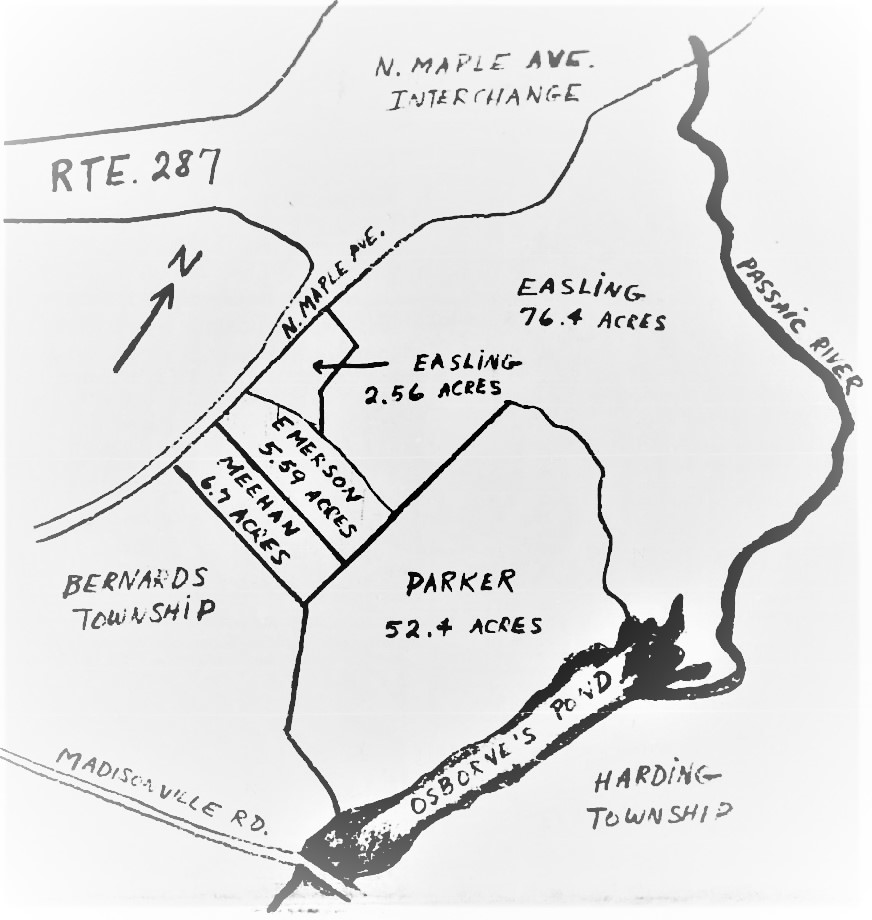
Starting in 1970, AT&T began acquiring real estate, which enabled the proposal to move forward. The first boundaries of the site in Bernards Township are bounded on the south by Madisonville Road, on the east by Osborn Pond, on the west by North Maple Avenue and Interstate 287, and on the north by a swamp and the Passaic River. As of 1971, AT&T would acquire tracts of land totaling 150 acres in Basking Ridge, New Jersey. Once completed, the 2.7 million square foot complex, situated just south of Interstate 287, would include 1.35 million square feet of office space. In conformance with local zoning requirements, the structures and buildings occupied only 10% of the 150 acres, complying well with the zoning ordinances. A new lake was even created, covering about 7 acres northwest of the building to serve as a settlement basin for water runoff and flood control.
AT&T was very busy over the summer of 1970 as they commenced their buying spree, negotiating with residents to acquire the needed property for the project. On October 27, 1970, it was reported that AT&T had finished acquiring its initial 144-acre site in Bernards Township for
Once the land acquisitions were completed, AT&T would prepare schematic drawings of the first designs for the AT&T board.
Want to share your history on the map? Send us a note with your story—Contact Us. AT&T also owned all but one of the 14 residential lots that front North Maple Avenue and Madisonville Road. Those lots, which include 11 homes, have assessments totaling .64 million.
As we find additional information regarding the properties, photos, and details, we will post them to this interactive Google map.
A number of homes on the AT&T property were either razed or relocated. AT&T was very sympathetic to keeping homes that were built in the mid-late 1700s. As we find additional information, we will add it to the accompanying interactive Google map above.
The project’s chief architect was James A. Barthold, who worked primarily for the Vincent Kling and Ballinger architectural firms in Philadelphia. He specialized in construction administration and overseeing the construction of the AT&T Basking Ridge project. Some of the more distinctive project features include a two-story cafeteria, wood-burning fireplaces, and an indoor waterfall. The structure’s design was set to two, three, and four-level offices. Two levels of garages would be underneath. Electrical and telephone lines were installed underground to provide a cleaner-looking environment.
The facility began in 1974 and was built in stages over a proposed 10-year period. Only on July 2, 1970, was it reported that the 45-day wait period had ended and the rezoning of the site was in effect. 5 additional property owner options were also executed. The building would use 28 acres of the total property. Architect Vincent Kling had previously won awards for campus-style layouts of industrial buildings. Only administrative business would be conducted at the site, and no research units would be present, as the Murray Hill Bell Labs served that purpose.
Heavy equipment used for the construction entered through the N. Maple Avenue entrance, and a second access point from Madisonville Road was used for construction workers to reach their paved parking area. The pavement was later removed and replaced with grass. A “truck wash” prevented dirt and mud from being tracked into nearby neighborhoods. An estimated 800 construction workers were on the site at any given time.
1975, November – The 2.7 million square foot complex, situated on 130 acres just south of Interstate 287, included 1.35 million square feet of office space in seven interconnected buildings and 1.35 million square feet of garage and mechanical space. There were 3,900 underground parking spaces and a helipad. The complex opened in November 1975, five years after AT&T assembled the tract and announced it would relocate its operational headquarters from Manhattan. Before long, local real estate values soared, and many homeowners were employees of the giant telecommunications company. Its doors opened to over 1,600 employees in 1975. They would add another 1,300 the following year, adding approximately 100 monthly additions.
AT&T also owned all but one of the 14 surrounding residential lots that front North Maple Avenue and Madisonville Road. Those lots, which include 11 homes, had assessments totaling .64 million. The lots were sold in a package with the complex. Another property that was later added was the AT&T Learning Center, a 171-room conference inn across the street at 300 North Maple Avenue.
1977 AT&T property assessed at .6 million. After a number of years of litigation between AT&T and the township, finally, in 1980, AT&T agreed to a tax rateable of approximately $ 3 million/year, which represented approximately 30% of the total annual municipal property tax.
At AT&T’s peak, nearly 6,000 employees worked at AT&T before the consolidation to other areas commenced. Mayor Robert M. Deane, commercial ratables became the state’s largest property tax appeal ever filed in New Jersey (Nov 26, 1979). The world’s biggest corporation agreed to an million real estate assessment for the AT&T General Department complex. The decision put over
For AT&T, the goal was to complete the initial construction of the facility by mid-1975 and relocate 1,200 employees to the new facility. True to their schedules, employees started moving into the facility in November 1975. Interestingly, AT&T reported that almost 99% of the employees were New Jersey residents, so relocation to Bernards Township would reduce their commute time to New York City. As a reference, homes in Murray Hill, averaging $60,000, were located near the Bell Labs facility. It was reported that homes were just $30.000 on average just five years before Bell arrived, and taxes had risen from $800 to over $1,200 on average. There was optimism for the real estate market, with the expectation that homes would also increase in value around Bernards Township.
On May 26, 1970, the secret was out, and AT&T announced that it was considering a location in Bernards Township for a new office complex. Then, on June 15, 1970, local newspapers promoted the news that the AT&T office plans were unopposed and moving forward. The area was chosen for its proximity to AT&T’s other key offices in Piscataway and Murray Hill.
Starting in 1970, AT&T began acquiring real estate, which enabled the proposal to move forward. The first boundaries of the site in Bernards Township are bounded on the south by Madisonville Road, on the east by Osborn Pond, on the west by North Maple Avenue and Interstate 287, and on the north by a swamp and the Passaic River. As of 1971, AT&T would acquire tracts of land totaling 150 acres in Basking Ridge, New Jersey. Once completed, the 2.7 million square foot complex, situated just south of Interstate 287, would include 1.35 million square feet of office space. In conformance with local zoning requirements, the structures and buildings occupied only 10% of the 150 acres, complying well with the zoning ordinances. A new lake was even created, covering about 7 acres northwest of the building to serve as a settlement basin for water runoff and flood control.
AT&T was very busy over the summer of 1970 as they commenced their buying spree, negotiating with residents to acquire the needed property for the project. On October 27, 1970, it was reported that AT&T had finished acquiring its initial 144-acre site in Bernards Township for $1.6 million, or about $11,100 per acre. The documents were filed with the offices of the Somerset County Clerk’s office on October 26, 1970. The area was within a newly created office/laboratory zone sanctioned by the Basking Ridge Planning and Zoning boards.
Once the land acquisitions were completed, AT&T would prepare schematic drawings of the first designs for the AT&T board.
Want to share your history on the map? Send us a note with your story—Contact Us. AT&T also owned all but one of the 14 residential lots that front North Maple Avenue and Madisonville Road. Those lots, which include 11 homes, have assessments totaling $4.64 million.
As we find additional information regarding the properties, photos, and details, we will post them to this interactive Google map.
A number of homes on the AT&T property were either razed or relocated. AT&T was very sympathetic to keeping homes that were built in the mid-late 1700s. As we find additional information, we will add it to the accompanying interactive Google map above.
The project’s chief architect was James A. Barthold, who worked primarily for the Vincent Kling and Ballinger architectural firms in Philadelphia. He specialized in construction administration and overseeing the construction of the AT&T Basking Ridge project. Some of the more distinctive project features include a two-story cafeteria, wood-burning fireplaces, and an indoor waterfall. The structure’s design was set to two, three, and four-level offices. Two levels of garages would be underneath. Electrical and telephone lines were installed underground to provide a cleaner-looking environment.
The facility began in 1974 and was built in stages over a proposed 10-year period. Only on July 2, 1970, was it reported that the 45-day wait period had ended and the rezoning of the site was in effect. 5 additional property owner options were also executed. The building would use 28 acres of the total property. Architect Vincent Kling had previously won awards for campus-style layouts of industrial buildings. Only administrative business would be conducted at the site, and no research units would be present, as the Murray Hill Bell Labs served that purpose.
Heavy equipment used for the construction entered through the N. Maple Avenue entrance, and a second access point from Madisonville Road was used for construction workers to reach their paved parking area. The pavement was later removed and replaced with grass. A “truck wash” prevented dirt and mud from being tracked into nearby neighborhoods. An estimated 800 construction workers were on the site at any given time.
1975, November – The 2.7 million square foot complex, situated on 130 acres just south of Interstate 287, included 1.35 million square feet of office space in seven interconnected buildings and 1.35 million square feet of garage and mechanical space. There were 3,900 underground parking spaces and a helipad. The complex opened in November 1975, five years after AT&T assembled the tract and announced it would relocate its operational headquarters from Manhattan. Before long, local real estate values soared, and many homeowners were employees of the giant telecommunications company. Its doors opened to over 1,600 employees in 1975. They would add another 1,300 the following year, adding approximately 100 monthly additions.
AT&T also owned all but one of the 14 surrounding residential lots that front North Maple Avenue and Madisonville Road. Those lots, which include 11 homes, had assessments totaling $4.64 million. The lots were sold in a package with the complex. Another property that was later added was the AT&T Learning Center, a 171-room conference inn across the street at 300 North Maple Avenue.
1977 AT&T property assessed at $93.6 million. After a number of years of litigation between AT&T and the township, finally, in 1980, AT&T agreed to a tax rateable of approximately $ 3 million/year, which represented approximately 30% of the total annual municipal property tax.
At AT&T’s peak, nearly 6,000 employees worked at AT&T before the consolidation to other areas commenced. Mayor Robert M. Deane, commercial ratables became the state’s largest property tax appeal ever filed in New Jersey (Nov 26, 1979). The world’s biggest corporation agreed to an $80 million real estate assessment for the AT&T General Department complex. The decision put over $2.4 million in the Bernards Twp. “kitty”. After building the facilities in Basking Ridge and Bedminster, AT&T became the largest taxpayer in Somerset County. Total yearly taxes were quoted at $3.9 million, or about 39% of the total collected in Bernards Township. In 1980, a special set of hearings was held to determine how to use the $2.4 million escrow.
As a good corporate citizen, AT&T contributed to local organizations during the construction, including two hospitals, the fire department, and the local first aid squad.
In 1975, there was a new corporate complex in Basking Ridge. Its seven low-slung buildings, attached by tunnels and walkways, hugged the hills and blended in with the countryside. The headquarters featured a two-story corporate cafeteria with wood-burning fireplaces, a heliport, and an indoor waterfall that cascades a ton of water a minute. Cars weren’t visible on the campus and were kept out of sight in a 3,900-space underground parking garage covering 15 acres. There was also a village with a bank, a barber, and other amenities.
The Suburban Action Institute put forth an interesting attempt to block the project in January 1971, a privately funded activist group, charged that AT&T was “committing racial and economic discrimination by relocating in a ‘discriminatorily zoned’ Bernards Township. The institute was asking the EEOC to block the project. “AT&T is fleeing from an urban area with heavy black and Spanish speaking populations to a “white oasis.”
It was later resolved in court. The opinion is that “No member of a minority will lose their job because of AT&T’s move to Basking Ridge. Anthony Pappas, public relations official for AT&T, is reacting to charges by the Suburban Action Institute. A second charge was introduced that there wasn’t any low or moderate-income residential housing in the area. This led to other future lawsuits and injunctions, initiated by Basking Ridge’s Roy McDonald Taylor and his wife, but they didn’t involve AT&T. Instead, they focused on the Bernards Township Planning Board and the Township Committee.
There were also claims that Mayor Peter Mangano and former Mayor Robert O’Neill had a conflict of interest with AT&T. Resident Tudor Finch made the accusations as a final attempt to halt the project using local ordinance #331. It was later backpedaled that there was a “possible conflict of interest” and not an “actual conflict of interest.” Nothing came from the suit.
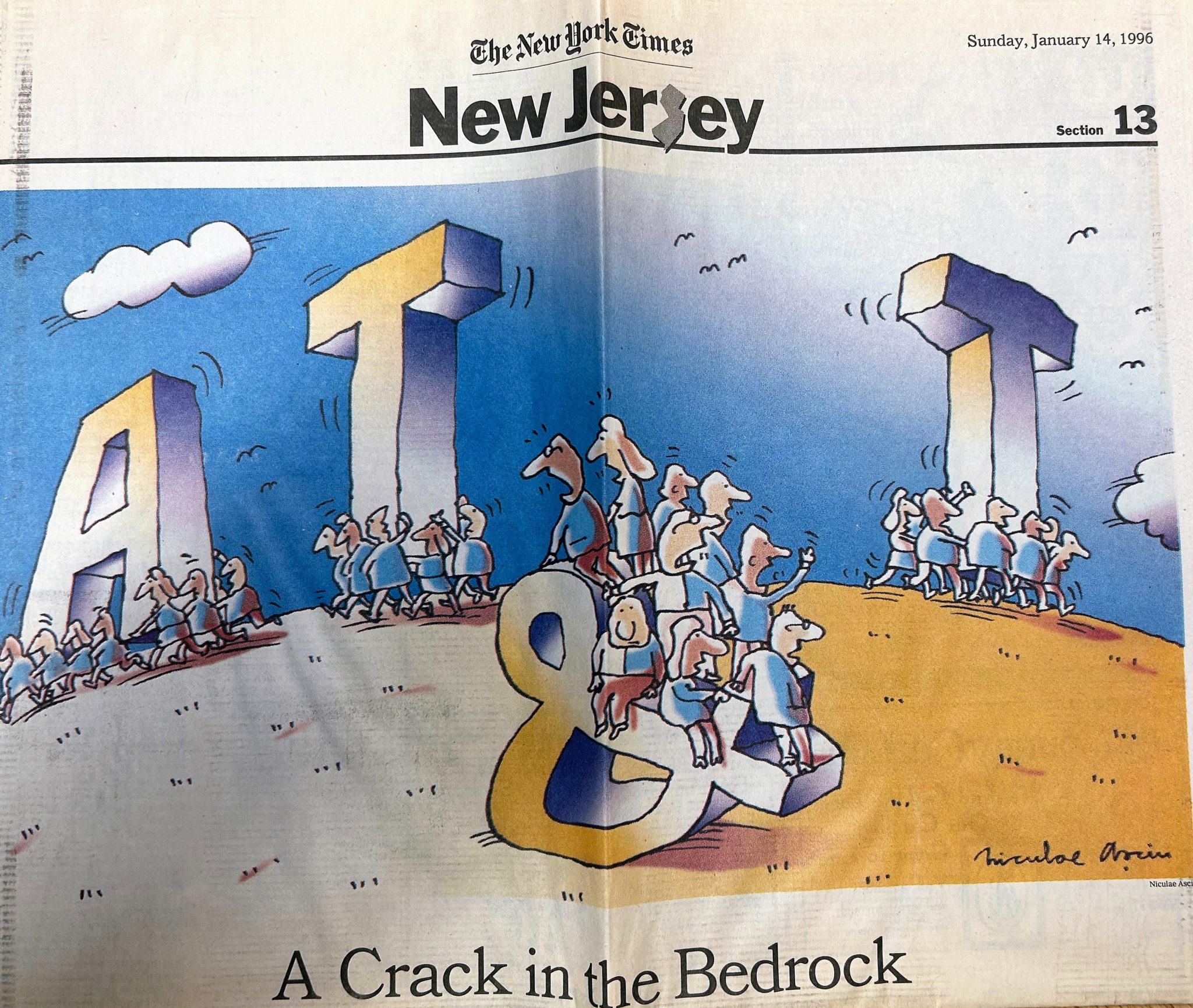
In 1996, signs started showing that there were problems at AT&T
AT&T sadly had to unload its bucolic corporate fortress in 2002, which analysts call the beginning of the end for the once mighty giant. The AT&T campus, which had grown to over 200 acres of rolling hills in horse country of northern New Jersey, was put on the block for more than $300 million. Ironically, after sitting vacant for years, it was first sold to Parmacia of Peapack, left vacant, and was finally scoffed up by Verizon Wireless as their corporate headquarters.
An interesting look at the Basking Ridge Fire Company’s training video taken at AT&T headquarters (VIDEO)
A special thank you to the Bernards Township Library for access to their history files and to the residents of Basking Ridge for sharing their thoughts and experiences during the period. As residents of Bernards Township and home to the Mr. Local History Project, we are always amazed at what we find during these retrospectives. Thanks all!
Remember AT&T’s Golden Boy with some fun retro swag.
[metaslider id=”14250″]
For AT&T, the goal was to complete the initial construction of the facility by mid-1975 and relocate 1,200 employees to the new facility. True to their schedules, employees started moving into the facility in November 1975. Interestingly, AT&T reported that almost 99% of the employees were New Jersey residents, so relocation to Bernards Township would reduce their commute time to New York City. As a reference, homes in Murray Hill, averaging $60,000, were located near the Bell Labs facility. It was reported that homes were just $30.000 on average just five years before Bell arrived, and taxes had risen from $800 to over $1,200 on average. There was optimism for the real estate market, with the expectation that homes would also increase in value around Bernards Township.
On May 26, 1970, the secret was out, and AT&T announced that it was considering a location in Bernards Township for a new office complex. Then, on June 15, 1970, local newspapers promoted the news that the AT&T office plans were unopposed and moving forward. The area was chosen for its proximity to AT&T’s other key offices in Piscataway and Murray Hill.
Starting in 1970, AT&T began acquiring real estate, which enabled the proposal to move forward. The first boundaries of the site in Bernards Township are bounded on the south by Madisonville Road, on the east by Osborn Pond, on the west by North Maple Avenue and Interstate 287, and on the north by a swamp and the Passaic River. As of 1971, AT&T would acquire tracts of land totaling 150 acres in Basking Ridge, New Jersey. Once completed, the 2.7 million square foot complex, situated just south of Interstate 287, would include 1.35 million square feet of office space. In conformance with local zoning requirements, the structures and buildings occupied only 10% of the 150 acres, complying well with the zoning ordinances. A new lake was even created, covering about 7 acres northwest of the building to serve as a settlement basin for water runoff and flood control.
AT&T was very busy over the summer of 1970 as they commenced their buying spree, negotiating with residents to acquire the needed property for the project. On October 27, 1970, it was reported that AT&T had finished acquiring its initial 144-acre site in Bernards Township for $1.6 million, or about $11,100 per acre. The documents were filed with the offices of the Somerset County Clerk’s office on October 26, 1970. The area was within a newly created office/laboratory zone sanctioned by the Basking Ridge Planning and Zoning boards.
Once the land acquisitions were completed, AT&T would prepare schematic drawings of the first designs for the AT&T board.
Want to share your history on the map? Send us a note with your story—Contact Us. AT&T also owned all but one of the 14 residential lots that front North Maple Avenue and Madisonville Road. Those lots, which include 11 homes, have assessments totaling $4.64 million.
As we find additional information regarding the properties, photos, and details, we will post them to this interactive Google map.
A number of homes on the AT&T property were either razed or relocated. AT&T was very sympathetic to keeping homes that were built in the mid-late 1700s. As we find additional information, we will add it to the accompanying interactive Google map above.
The project’s chief architect was James A. Barthold, who worked primarily for the Vincent Kling and Ballinger architectural firms in Philadelphia. He specialized in construction administration and overseeing the construction of the AT&T Basking Ridge project. Some of the more distinctive project features include a two-story cafeteria, wood-burning fireplaces, and an indoor waterfall. The structure’s design was set to two, three, and four-level offices. Two levels of garages would be underneath. Electrical and telephone lines were installed underground to provide a cleaner-looking environment.
The facility began in 1974 and was built in stages over a proposed 10-year period. Only on July 2, 1970, was it reported that the 45-day wait period had ended and the rezoning of the site was in effect. 5 additional property owner options were also executed. The building would use 28 acres of the total property. Architect Vincent Kling had previously won awards for campus-style layouts of industrial buildings. Only administrative business would be conducted at the site, and no research units would be present, as the Murray Hill Bell Labs served that purpose.
Heavy equipment used for the construction entered through the N. Maple Avenue entrance, and a second access point from Madisonville Road was used for construction workers to reach their paved parking area. The pavement was later removed and replaced with grass. A “truck wash” prevented dirt and mud from being tracked into nearby neighborhoods. An estimated 800 construction workers were on the site at any given time.
1975, November – The 2.7 million square foot complex, situated on 130 acres just south of Interstate 287, included 1.35 million square feet of office space in seven interconnected buildings and 1.35 million square feet of garage and mechanical space. There were 3,900 underground parking spaces and a helipad. The complex opened in November 1975, five years after AT&T assembled the tract and announced it would relocate its operational headquarters from Manhattan. Before long, local real estate values soared, and many homeowners were employees of the giant telecommunications company. Its doors opened to over 1,600 employees in 1975. They would add another 1,300 the following year, adding approximately 100 monthly additions.
AT&T also owned all but one of the 14 surrounding residential lots that front North Maple Avenue and Madisonville Road. Those lots, which include 11 homes, had assessments totaling $4.64 million. The lots were sold in a package with the complex. Another property that was later added was the AT&T Learning Center, a 171-room conference inn across the street at 300 North Maple Avenue.
1977 AT&T property assessed at $93.6 million. After a number of years of litigation between AT&T and the township, finally, in 1980, AT&T agreed to a tax rateable of approximately $ 3 million/year, which represented approximately 30% of the total annual municipal property tax.
At AT&T’s peak, nearly 6,000 employees worked at AT&T before the consolidation to other areas commenced. Mayor Robert M. Deane, commercial ratables became the state’s largest property tax appeal ever filed in New Jersey (Nov 26, 1979). The world’s biggest corporation agreed to an $80 million real estate assessment for the AT&T General Department complex. The decision put over $2.4 million in the Bernards Twp. “kitty”. After building the facilities in Basking Ridge and Bedminster, AT&T became the largest taxpayer in Somerset County. Total yearly taxes were quoted at $3.9 million, or about 39% of the total collected in Bernards Township. In 1980, a special set of hearings was held to determine how to use the $2.4 million escrow.
As a good corporate citizen, AT&T contributed to local organizations during the construction, including two hospitals, the fire department, and the local first aid squad.
In 1975, there was a new corporate complex in Basking Ridge. Its seven low-slung buildings, attached by tunnels and walkways, hugged the hills and blended in with the countryside. The headquarters featured a two-story corporate cafeteria with wood-burning fireplaces, a heliport, and an indoor waterfall that cascades a ton of water a minute. Cars weren’t visible on the campus and were kept out of sight in a 3,900-space underground parking garage covering 15 acres. There was also a village with a bank, a barber, and other amenities.
The Suburban Action Institute put forth an interesting attempt to block the project in January 1971, a privately funded activist group, charged that AT&T was “committing racial and economic discrimination by relocating in a ‘discriminatorily zoned’ Bernards Township. The institute was asking the EEOC to block the project. “AT&T is fleeing from an urban area with heavy black and Spanish speaking populations to a “white oasis.”
It was later resolved in court. The opinion is that “No member of a minority will lose their job because of AT&T’s move to Basking Ridge. Anthony Pappas, public relations official for AT&T, is reacting to charges by the Suburban Action Institute. A second charge was introduced that there wasn’t any low or moderate-income residential housing in the area. This led to other future lawsuits and injunctions, initiated by Basking Ridge’s Roy McDonald Taylor and his wife, but they didn’t involve AT&T. Instead, they focused on the Bernards Township Planning Board and the Township Committee.
There were also claims that Mayor Peter Mangano and former Mayor Robert O’Neill had a conflict of interest with AT&T. Resident Tudor Finch made the accusations as a final attempt to halt the project using local ordinance #331. It was later backpedaled that there was a “possible conflict of interest” and not an “actual conflict of interest.” Nothing came from the suit.
In 1996, signs started showing that there were problems at AT&T
AT&T sadly had to unload its bucolic corporate fortress in 2002, which analysts call the beginning of the end for the once mighty giant. The AT&T campus, which had grown to over 200 acres of rolling hills in horse country of northern New Jersey, was put on the block for more than $300 million. Ironically, after sitting vacant for years, it was first sold to Parmacia of Peapack, left vacant, and was finally scoffed up by Verizon Wireless as their corporate headquarters.
An interesting look at the Basking Ridge Fire Company’s training video taken at AT&T headquarters (VIDEO)
A special thank you to the Bernards Township Library for access to their history files and to the residents of Basking Ridge for sharing their thoughts and experiences during the period. As residents of Bernards Township and home to the Mr. Local History Project, we are always amazed at what we find during these retrospectives. Thanks all!
Remember AT&T’s Golden Boy with some fun retro swag.
[metaslider id=”14250″]
As a good corporate citizen, AT&T contributed to local organizations during the construction, including two hospitals, the fire department, and the local first aid squad.
In 1975, there was a new corporate complex in Basking Ridge. Its seven low-slung buildings, attached by tunnels and walkways, hugged the hills and blended in with the countryside. The headquarters featured a two-story corporate cafeteria with wood-burning fireplaces, a heliport, and an indoor waterfall that cascades a ton of water a minute. Cars weren’t visible on the campus and were kept out of sight in a 3,900-space underground parking garage covering 15 acres. There was also a village with a bank, a barber, and other amenities.
The Suburban Action Institute put forth an interesting attempt to block the project in January 1971, a privately funded activist group, charged that AT&T was “committing racial and economic discrimination by relocating in a ‘discriminatorily zoned’ Bernards Township. The institute was asking the EEOC to block the project. “AT&T is fleeing from an urban area with heavy black and Spanish speaking populations to a “white oasis.”
It was later resolved in court. The opinion is that “No member of a minority will lose their job because of AT&T’s move to Basking Ridge. Anthony Pappas, public relations official for AT&T, is reacting to charges by the Suburban Action Institute. A second charge was introduced that there wasn’t any low or moderate-income residential housing in the area. This led to other future lawsuits and injunctions, initiated by Basking Ridge’s Roy McDonald Taylor and his wife, but they didn’t involve AT&T. Instead, they focused on the Bernards Township Planning Board and the Township Committee.
There were also claims that Mayor Peter Mangano and former Mayor Robert O’Neill had a conflict of interest with AT&T. Resident Tudor Finch made the accusations as a final attempt to halt the project using local ordinance #331. It was later backpedaled that there was a “possible conflict of interest” and not an “actual conflict of interest.” Nothing came from the suit.
In 1996, signs started showing that there were problems at AT&T
AT&T sadly had to unload its bucolic corporate fortress in 2002, which analysts call the beginning of the end for the once mighty giant. The AT&T campus, which had grown to over 200 acres of rolling hills in horse country of northern New Jersey, was put on the block for more than 0 million. Ironically, after sitting vacant for years, it was first sold to Parmacia of Peapack, left vacant, and was finally scoffed up by Verizon Wireless as their corporate headquarters.
An interesting look at the Basking Ridge Fire Company’s training video taken at AT&T headquarters (VIDEO)